


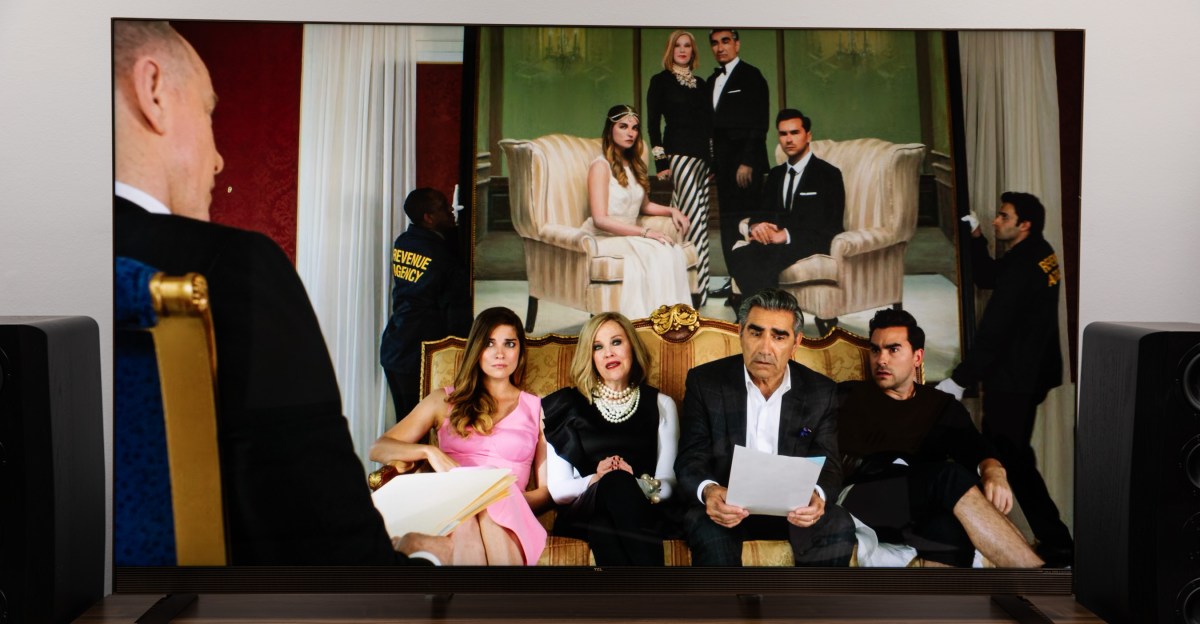

 The TCL X11L is the most impressive TV of the year, but the year is still young and RGB LED is on the horizon.
The TCL X11L SQD-Mini LED TV garnered significant interest at a pre-CES event in December, with initial impressions leading to its recognition as the best TV of CES 2026.
Upon completing the Google TV setup, the TCL X11L immediately demonstrated remarkable performance. It is notably one of the brightest TVs available, but its color vibrancy stands out as particularly impressive. Common colors like skin tones, the sky, and natural greens appear exceptionally realistic, contributing to a stunning visual experience.
It’s a flagship TV unlike any other that TCL has made, with vibrant colors and incredible blooming control. It competes with flagships from all the major TV manufacturers — including the Sony Bravia 9, LG G5, and Samsung S95F — and it gets brighter than any of them. However, it comes with a premium price tag; the 75-inch model is priced at $7,000, while the 85-inch and 98-inch versions cost $8,000 and $10,000, respectively. And with a bunch of RGB LED TVs on the way this year, for likely comparable prices, you might want to wait before committing to the X11L.


TCL X11L SQD-Mini LED TV
The Good
- Exceptionally bright
- Accurate, especially with minor tweaks
- Solidly built
- Impressive sound
The Bad
- Expensive
- Slight red drift as it warms up
$7000 at Amazon (75-inch)$8000 at Best Buy (85-inch)$8000 at Amazon (85-inch)
While the TV industry leans into RGB LED — and TCL is too, on other TVs — TCL’s flagship instead uses an evolution of mini-LED technology. The X11L uses blue LEDs for its backlight with super quantum dots (hence the SQD) and an upgraded color filter that together provide a wide color gamut coverage for a mini-LED TV. Both technologies should have similar light output and color performance, although the individual red, green, and blue LED backlights of RGB LEDs could deliver more accurate colors — or they could have
. The full potential of RGB LED TVs will become clearer once they are more widely available. Mini-LED is a well-established technology, and TCL has notably advanced its performance with the X11L.
It also has a higher-end design than previous TCL TVs, with a solid metal frame and uniform thickness across the chassis that’s just about an inch deep. It uses a B&O audio system, including front-firing speakers along the bottom of the TV that deliver clear dialogue and, with the built-in subwoofers, surprisingly deep and booming bass. (The system can also be expanded with TCL’s Z100 FlexConnect speakers, which are expected to be tested in the near future.)
TCL X11L specs
Display type: Mini LED with super quantum dots
Backlight: Blue LEDs
HDR formats: Dolby Vision, HDR10+, HDR10, HLG
OS: Google TV
HDMI inputs: 4 x HDMI 2.1 (one with eARC/ARC)
Audio support: Dolby Atmos, DTS Virtual X
Gaming features: 4K/144Hz, VRR (up to 288Hz), ALLM, FreeSync Premium Pro
Sizes available (inches): 75, 85, 98
Filmmaker mode typically offers the most accurate picture, and testing indicates strong grayscale performance from TCL, with a minor tendency to slightly crush blacks. At default settings, the TCL tracks slightly below the
(meaning the gray approaching white is not quite as bright as expected). Increasing the brightness from the default 50 to 70 resulted in almost perfect EOTF tracking and very good grayscale performance, aside from the slight dimness in near-black areas. While not as accurate as the LG G5 OLED, it is comparable to the Sony Bravia 9, and the TCL can achieve significantly higher brightness in Filmmaker mode than either.
Default Filmmaker mode isn’t the brightest of the modes available, with a 10 percent window peaking at 2,789 nits, but the X11L can easily get brighter. Using a Konica Minolta LS-100 luminance meter (which offers greater reliability above 6,000 nits compared to colorimeters and spectrophotometers), measurements showed just over 8,800 nits from a 5 percent window in Filmmaker mode, with brightness at 100, local contrast at high, and peak brightness set to boost. By comparison, the mini-LED TCL QM9K hit 5,844 nits, and the brightest OLED of last year, the LG G5, topped out at 2,340 nits, both also in Filmmaker mode.
 The X11L achieves exceptionally high peak brightness.
While it’s great that the TV can hit that, especially in its most accurate color mode, for the vast majority of people and their living rooms it isn’t necessary. For typical viewing, a brightness setting of 70, medium local contrast, and high peak brightness are often suitable. In darker environments, reducing the brightness further may be preferred as extreme brightness becomes unnecessary.
Changing the brightness is quicker than on any other TV because TCL added brightness buttons (and a picture mode button) to the side of the remote. This feature is likely to be appreciated by reviewers and display enthusiasts, as it significantly enhances usability. Otherwise it’s just like last year’s TCL TV remote, including an input select button, a mic for voice commands, and a settings button, and it’s backlit.
 The backlit remote is similar to last year’s, with useful buttons including input select, and…
 …new brightness and picture mode select buttons on the side of the remote are the best addition since remote backlighting.
Some TV reviewers have suggested that Movie mode might be more accurate than Filmmaker mode on their samples. Further testing indicated that while Movie mode is brighter at its default settings, it did not prove as accurate in these tests. A comparison of the two modes revealed a slight decrease in the accuracy of the red channel in the grayscale over extended viewing periods.
A series of tests performed in the morning yielded measurements close to the initial setup. After the TV was left on for four hours, re-measurement with the same tests, confirmed that the red channel measurements in the grayscale test were lower than those recorded earlier. Although this change is detectable in testing, the difference is minor and occurs gradually over several hours. It is unlikely to be noticeable during typical viewing. However, for those considering a $7,000 TV, this detail may be relevant.
TV Testing Methodology
Each TV is set up in a living room environment on a home theater credenza. Movies and shows are streamed through the TV’s apps, and discs are played on a Magnetar UDP900 MkII 4K Blu-Ray player (including the Spears & Munsil Ultra HD Benchmark disc), alongside movies from a Kaleidescape Strato V player. Gaming performance is assessed using an Xbox Series X and PlayStation 5. Testing occurs at various times of day and under different lighting conditions, including with open curtains, lamps and overhead lights on, or with blackout curtains for a dark room. While ISF Level 3 calibration certification is held, TVs are not calibrated before measurement, as most TV owners do not perform this step. Therefore, understanding out-of-the-box performance with minor, user-friendly menu adjustments is crucial.
Measurement tools include Portrait Displays’ Calman color calibration software, a Murideo 8K Seven pattern generator, an X-rite i1 Pro 3 spectrophotometer, Portrait Displays’ C6 HDR5000 colorimeter, a Konica Minolta LS-100 luminance meter, and a Leo Bodnar 4K lag tester.
The X11L delivers a spectacular viewing experience. Scenes like the fire and explosions in the desert chase from Mad Max: Fury Road appear dazzling, and the lush green trees of Rivendell are inviting and realistic. Its blooming control is notably superior for a mini-LED, surpassing even last year’s TCL flagship, the QM9K. There’s a sharp separation between bright elements that are right next to black. It’s still not at the level that OLED can achieve with its pixel-level control, but its performance is closer than it’s ever been.
The X11L demonstrates excellent handling of fast motion, observed during various sports events. While the Sports picture mode includes motion compensation and clarity settings (noise reduction, super resolution, and sharpness), it tends to be overly blue. Opting for Filmmaker mode and selectively enabling these settings for sports viewing, which is easily done via the Picture Settings menu, yields better results. Low motion compensation effectively smooths fast action like a football pass or triple lutz without appearing artificial, though a medium setting can be excessive. Noise reduction and super resolution settings enhance 1080p broadcast TV signals by upscaling and cleaning up artifacts. While its processing may not match Sony’s, it represents a significant improvement for TCL. The Google OS on the X11L operates smoothly, with frequently used apps like HBO Max, Prime Video, Peacock, and Netflix launching quickly and offering responsive navigation. As a gaming TV, the X11L excels, managing motion effectively and supporting high frame rates from both consoles and PCs. Extended gaming sessions in Forza Horizon 5 and F1 24 on an Xbox Series X and PC showed no screen tearing, smearing, or input lag issues.
 The X11L uses Google TV as its operating system, which runs quickly and smoothly.
 The X11L has front-facing B&O speakers behind a grille that runs the length of the TV.
 Colors on the TCL are absolutely stunning, and images look incredibly realistic.
With every TV manufacturer hyping RGB LED TVs this year — and TCL itself releasing an RGB LED TV this year — it may seem like a gamble to stick with mini LED for its flagship, even if it does push the technology forward. It remains to be seen whether the claims of RGB LED TVs’ color accuracy and
hold true with actual content, beyond carefully curated demo screens, until more models are released.
But maybe the fact that TCL’s choice of mini-LED for the X11L is a hint that RGB LED isn’t quite ready to overtake mini LED — if it ever does. The X11L’s pricing in comparison to upcoming 2026 RGB LED TVs is also yet to be determined. Last year’s 100-inch Hisense UX is currently available for $13,000 (down from $20,000), which is still considerably higher than the $10,000 TCL is asking for the 98-inch X11L.
Based on recent observations, the TCL X11L SQD-Mini LED TV appears poised to be a top contender for the best TV of the year. TCL’s advancements in mini-LED technology with this model are undeniably impressive.
Despite its impressive performance, a definitive recommendation to purchase the X11L immediately is difficult, particularly as its comparison to RGB LED technology is still pending. Historically, TCL TV prices tend to decrease throughout the year. For instance, last year’s 85-inch X11K, initially priced at $10,000, is now available for $3,500, suggesting a similar trend for the X11L. If its price eventually aligns within $1,000 of the Bravia 9 or LG G5, the X11L would present a compelling value.
