


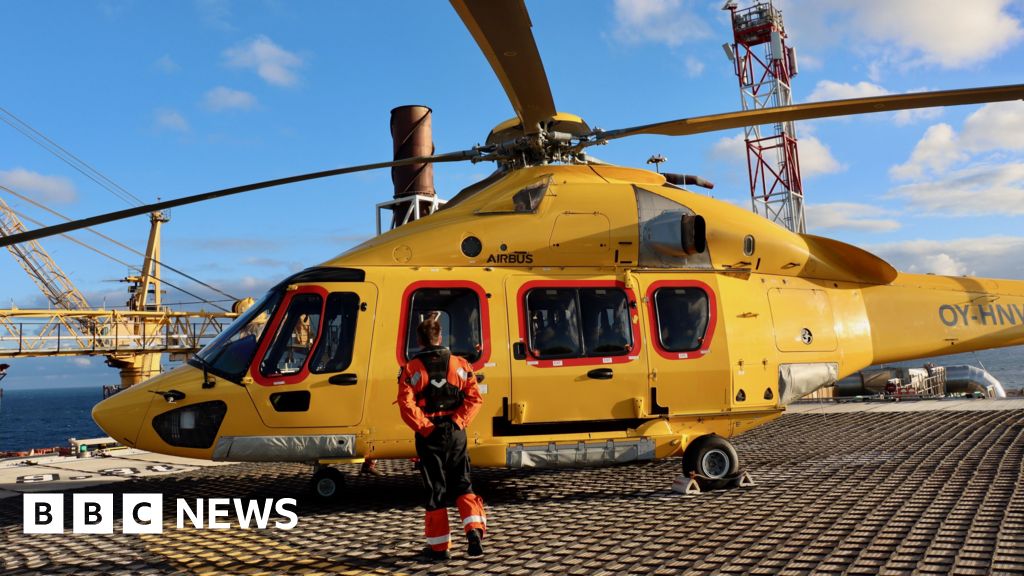
An offshore landing takes place on a platform located 250km (155 miles) from Denmark’s west coast. The helicopter circles Nini, a rig in the North Sea, which sits above an almost-depleted oilfield. This site is slated for a new purpose as a significant carbon storage initiative known as Greensand Future.
The project’s objective is to inject thousands of tonnes of climate-warming CO2 into the former oil field. The Siri “mother platform” serves as a control center for offshore operations. Mads Gade, CEO of Ineos Energy, highlights the wellhead’s large pipes, which previously transported oil and gas from beneath the seabed for decades.
Gade explains that instead of extracting oil and gas, CO2 will now be injected into the ground.

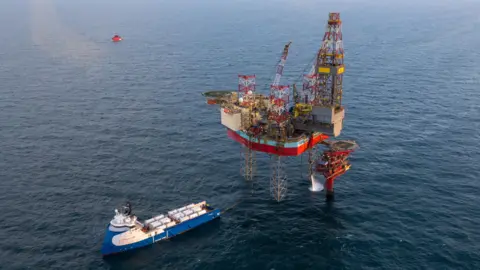
Carbon Capture and Storage (CCS) technology involves capturing and permanently storing carbon dioxide. Greensand Future, supported by a consortium led by British multinational chemicals company Ineos, is poised to become the EU’s inaugural large-scale offshore CO2 storage facility once commercial operations begin in the coming months.
The company projects storing approximately 400,000 tonnes of CO2 this year, with potential growth to eight million tonnes annually by 2030. Gade notes this could account for nearly 40% of Denmark’s emission reduction target, indicating its substantial impact.
Leading climate science bodies, including the Intergovernmental Panel on Climate Change (IPCC) and the International Energy Agency (IEA), emphasize that carbon capture and removal technologies are crucial for limiting global warming, alongside significant and rapid emission cuts. The EU also states that CCS is necessary to achieve “net zero” emissions by 2050.
However, CCS technology faces criticism, with some warning it might deter efforts to reduce CO2 emissions. Its high cost is also a concern, as environmental groups argue that emission reductions could be achieved more affordably using established technologies like wind power, solar energy, and electric vehicles.
Helene Hagel, head of climate and environmental policy at Greenpeace Denmark, expresses support for CCS in sectors where emissions are genuinely difficult or impossible to abate, but questions its application in other areas. Hagel also raises concerns about future generations, suggesting that using the seabed for carbon storage now might limit its availability for future emissions if current generations fail to adequately reduce their own.
Globally, hundreds of CCS initiatives are either active or under development. In Europe, several major projects are progressing in the North Sea region, notably in Norway, the Netherlands, Denmark, and the UK.
Norway’s Northern Lights project, introduced as the world’s first commercial carbon storage service, began storing CO2 under the seabed off Bergen last August. In the UK, various carbon capture clusters are being developed, including Scotland’s Acorn Project and the Viking project off Lincolnshire.
The North Sea’s history of oil and gas production is a key factor in its emergence as a CCS hub. Niels Schovsbo, a senior researcher at the Geological Survey of Greenland and Denmark (GEUS), notes that decades of production have thoroughly explored the geology of potential storage sites. Existing offshore infrastructure and technical expertise also contribute to this suitability. Gade points out that reusing facilities, skills, and competencies from fields like Nini, which is nearing the end of its operational life, is a significant advantage.
In a Copenhagen warehouse, rock samples drilled from the seafloor are stored. Schovsbo explains that the North Sea’s geology is well-suited for CO2 storage due to the rock’s porous nature, which can hold the CO2. A thick layer of clay or cap rock, nearly a kilometer deep, will seal the CO2, mirroring how it trapped oil and gas for millions of years. Schovsbo indicates that a comparable volume of CO2 can be stored to the amount of oil and gas extracted, suggesting an operational lifespan of 10 to 30 years for CCS sites.
Carbon storage presents new opportunities for the region’s offshore workers. Peter Bjerre, a maintenance manager, states that much of the work currently involving turbine and gas compressor maintenance will transition to maintaining high-pressure pumps for CO2 injection. Bjerre, an Esbjerg local, reflects on the region’s economic evolution from fishing to oil and gas, and now to a future built on the green transition.
