


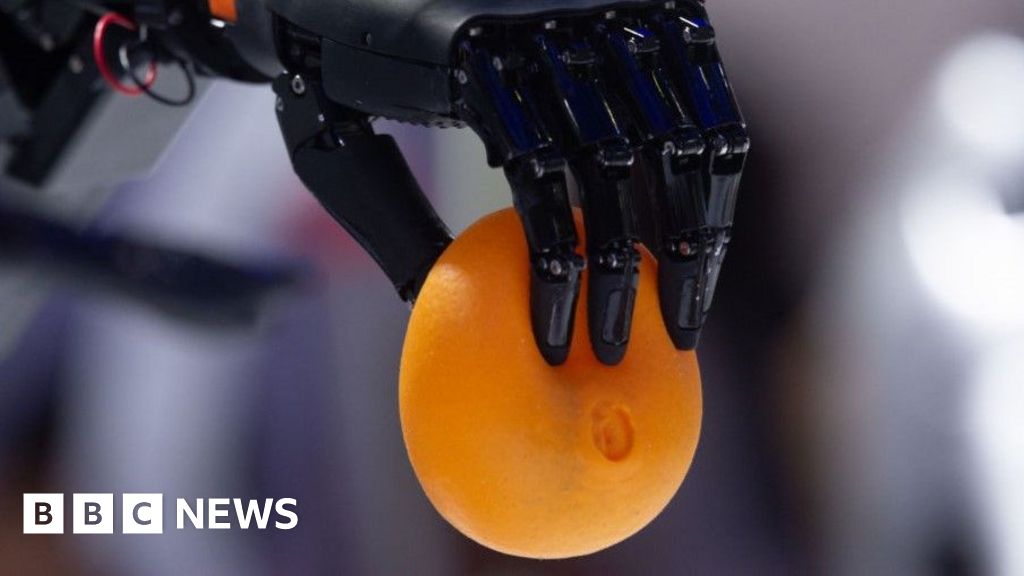
Rich Walker, a director at Shadow Robot, recalls the company’s initial robotic hand from the late 1990s, which was crafted using simple materials like wood, springs, and rubber bands. Walker noted that much of it was assembled from readily available items.
At Shadow Robot’s north London headquarters, the latest robotic hands are on display. These hands feature cylindrical “forearms” containing small electric motors, or actuators, which precisely move the fingers by pulling on metal tendons. Operating the robotic hands involves strapping sensors to a user’s fingers and following simple instructions. A beginner might anticipate uncontrolled movements, potentially knocking over objects. However, the movements prove smooth and precise, allowing for immediate manipulation of blocks and cups.
Approximately 200 of these robotic hands are currently in use, primarily by researchers in universities and technology companies. Walker describes these hands as a “development kit for dexterity,” allowing users to explore capabilities and inform the design of larger systems or projects.

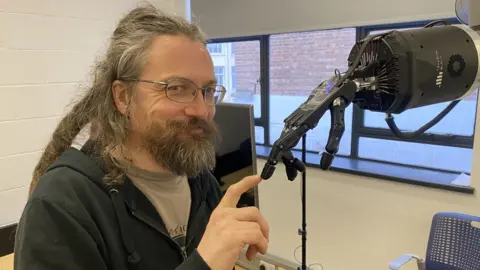
This development is crucial for robots to effectively operate in human environments, where most tools and devices are designed for human hands.
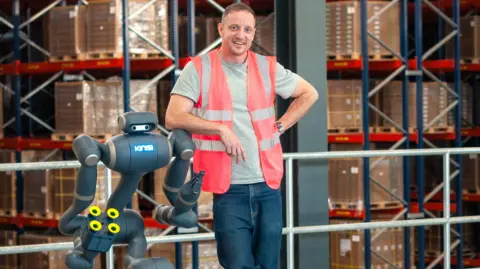
Bren Pierce, founder of Bristol-based robotics start-up Kinisi, states that “the hand is the hardest, most complex part of any humanoid robot.”
Kinisi’s KR1 robots are currently undergoing commercial trials. These robots can be equipped with various grippers; for instance, robust “gorilla” pincers handle heavy boxes, while a suction device is used for more delicate objects. However, like many in the industry, Pierce aims to develop a single, versatile hand capable of performing all tasks. Pierce notes that “everyone has been dreaming for 40 years of one robot hand to rule the world,” with many believing the humanoid hand could be the solution. Kinisi has developed a three-fingered hand, described as “pretty good.” The current challenge, according to Pierce, is making it robust, scalable, and affordable.
The prototype hand from Kinisi costs approximately £4,000 ($5,400) to produce, significantly more than the £400 simple pincer currently employed by the company.
Tesla CEO Elon Musk highlighted the difficulty of creating a robust, dexterous, and affordable robotic hand during a presentation
in Los Angeles last September. Musk identified hand development as one of three major hurdles for humanoid robotics, alongside developing AI for world comprehension and mass production. Significant attention is expected for the upcoming launch of Tesla’s latest humanoid robot, Optimus, later this year. Musk has promised Optimus will possess “the manual dexterity of a human,” implying a highly complex hand.
Professor Nathan Lepora, an expert in Robotics and AI at Bristol University, dismisses this claim, stating that human-level dexterity is still distant, despite his career focus on robot hands. He estimates it will take approximately 10 years to achieve this, which he considers a relatively short timeframe.
Lepora is involved in a robotics project under the UK government’s Aria research and development scheme. Similar to the Shadow Robot design, Lepora’s work focuses on hands that utilize “tendons” for finger movement. He believes that “longer-term, tendon-driven hands using more sophisticated mechanisms will result in more affordable and capable hands.”
However, Lepora has been impressed by Chinese firms that are advancing by integrating motors directly into fingers and hands for movement, rather than relying on tendons. He explains that in China, motor manufacturers are collaborating with hand hardware developers to create custom motors that fit within joints and fingers, which “is probably going to work as an effective hand.”
Shanghai-based Wuji Technology is one such firm. Its latest hand features four independently controlled joints in each finger, enabling intricate movements. Yunzhe Pan, Wuji co-founder, states the hand is durable and will be made even more so in future generations. Currently, each hand sells for $12,000 (£8,800), though Pan indicates it will become more affordable.
The Wuji hand incorporates piezoelectric sensors, which convert pressure into an electrical charge, providing a sense of touch. Developing a durable sense of touch for robots represents a significant breakthrough for humanoid robotics. However, Pierce points out that this area still requires substantial development. He explains that while research labs and start-ups often showcase impressive sensors, their typical lifespan of “six months” is insufficient for industrial applications, where a robot needs to function for 10 years.
Despite these challenges, there is cause for optimism. Lepora notes that tactile sensing historically seemed a decade away, but believes the billions of dollars now invested in humanoid robots are accelerating progress. He concludes that “things are changing.”
