


The Interop Project serves as a crucial collaborative effort among browser vendors to enhance the web platform. It identifies and addresses key areas where discrepancies between browser engines affect users and developers, thereby supporting the long-term health of the open web.
Interoperability, grounded in common standards, forms the foundation of the web platform. This provides users with choice and control, distinguishing the web from proprietary platforms. Maintaining an open and interoperable web is a core principle for many, reflected in the commitment to independent browser engines.
Maintaining interoperability demands continuous effort. Discrepancies between browser implementations and standards create challenges for web developers. They often face a choice: either avoid a problematic feature or adapt code to specific browser behaviors. If too much content becomes implementation-specific, interoperability diminishes, impacting user freedom.
The Interop Project aims to resolve these issues. It unites browser vendors to prioritize interoperability, enabling the identification of current and potential interoperability problems. Publicly tracking progress on these issues ensures accountability to the wider web community.
The project operates by defining high-priority focus areas—parts of the web platform where interoperability enhancements are deemed highly valuable. These include existing features with known browser behavior differences causing developer issues, or new features highly requested by web developers that should launch with strong interoperability. For each focus area, a selection of web-platform-tests is chosen, and a score is calculated based on their pass rate.
Interop 2023
The Interop 2023 project addressed significant features such as the new :has() selector and web-codecs, alongside areas historically lacking interoperability like pointer events.
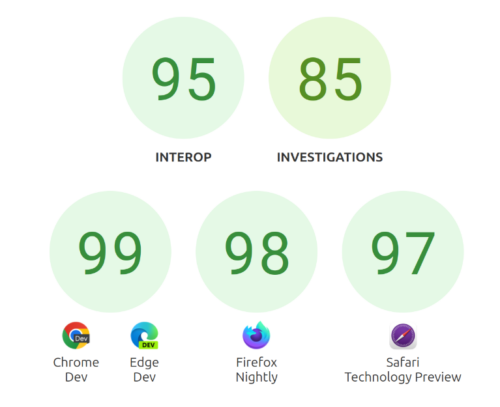
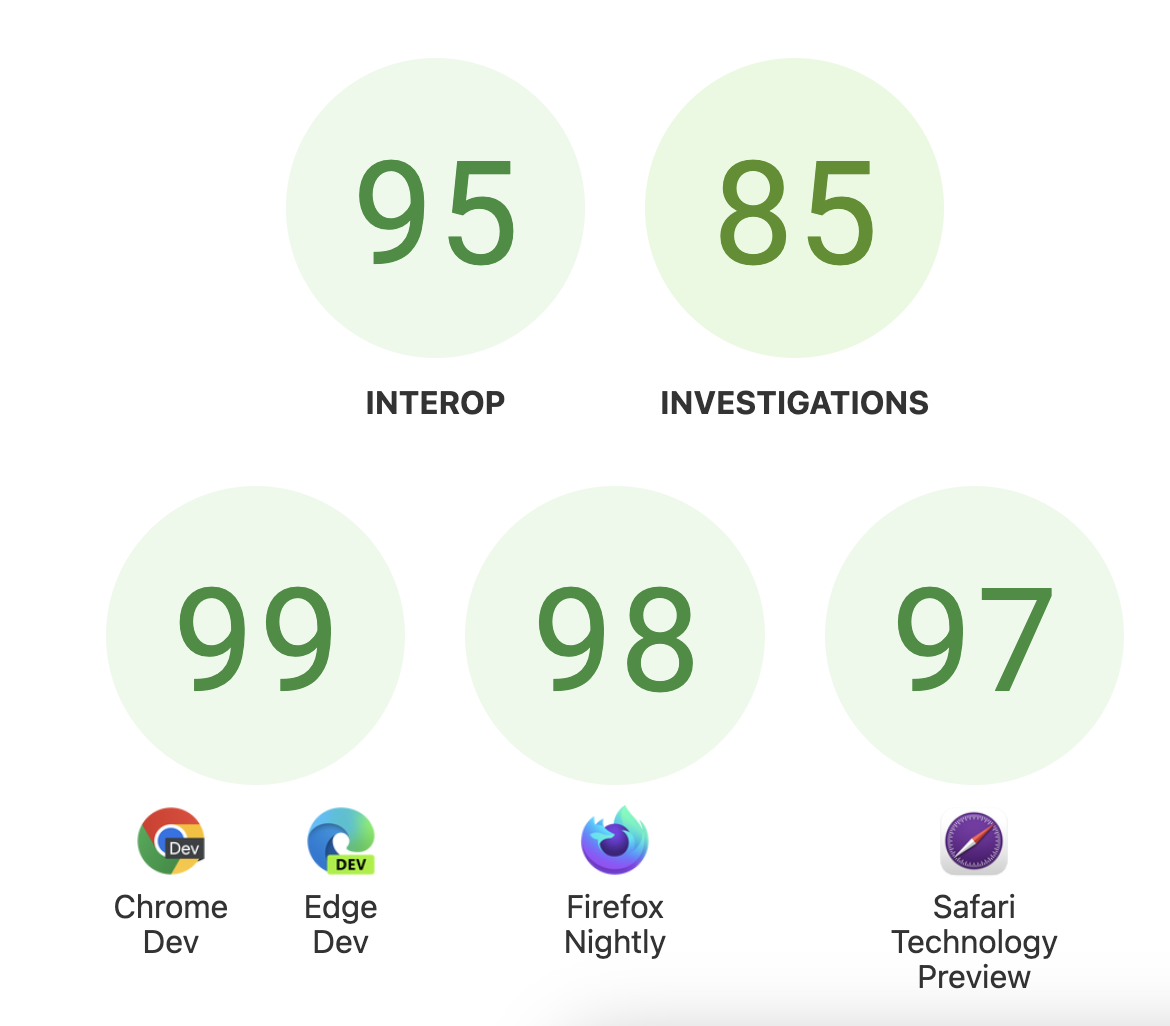
The results of the project demonstrated significant success: all participating browsers achieved scores over 97% for their prerelease versions by year-end. Furthermore, the overall Interoperability score—representing the percentage of focus area tests passing in all participating browser engines—rose from 59% to 95%. This marks a substantial improvement in the web platform’s consistency and reliability, promising users a more seamless experience with websites functioning predictably across their preferred browsers.
Regarding the :has() selector, a highly requested CSS feature, every implementation now passes 100% of the web-platform-tests designated for its focus area. Introducing a major new platform feature with such high interoperability highlights the Interop project’s effectiveness in advancing the platform while preserving implementation diversity, enhancing developer experience, and supporting user choice.
Beyond focus areas, the Interop project also includes “investigations”. These are areas requiring interoperability improvements but lacking specific measurable tests. In 2023, two investigations were conducted. The first focused on accessibility, involving the creation of numerous new tests for ARIA computed role and accessible name, and ensuring their cross-browser compatibility. The second addressed mobile testing, leading to initial results for Mobile Firefox and Chrome for Android on wpt.fyi.
Interop 2024
Building on the success of Interop 2023, the project is set to continue in 2024 with a fresh selection of focus areas. These areas represent parts of the web platform where the greatest positive impact on users and web developers is anticipated.
New Focus Areas
New focus areas for 2024 include, among other things:
- Popover API – This offers a declarative way to create content that consistently appears in the topmost layer, overlaying other webpage content. It is useful for features such as tooltips and notifications. The Popover API was the top author request in the recent State of HTML survey.
- CSS Nesting – This already-available feature enables writing more compact and readable CSS without external tools like preprocessors. Different browsers, however, implemented slightly varied behaviors based on different specification revisions. Interop aims to ensure alignment on a single, reliable syntax for this popular feature.
- Accessibility – Making the web accessible to all users is a crucial aspect of the web platform. The inclusion of Accessibility testing in Interop 2024 stems directly from the successful Interop 2023 Accessibility Investigation, which significantly increased test coverage for key accessibility features.
The full list of focus areas is available in the project README.
Carryover
Beyond the new focus areas, several 2023 focus areas will be carried over due to remaining work. Notably, the Layout focus area will merge previous Flexbox, Grid, and Subgrid areas into a single comprehensive area for modern web layout primitives. Additionally, Custom Properties, URL, and Mouse and Pointer Events focus areas will continue. These represent areas where, despite significant interoperability improvements already achieved, further convergence among implementations is expected to benefit users and web developers.
Investigations
In addition to focus areas, Interop 2024 will introduce a new investigation aimed at enhancing WebAssembly testing integration into web-platform-tests, potentially allowing WASM features in future Interop projects. The Accessibility and Mobile Testing investigations will also be extended, as further effort is needed to ensure these platform aspects are fully testable across various implementations.
Partner Announcements
- Apple: The web just gets better with Interop, now for 2024
- Bocoup: Interop 2024
- Google: Interop 2024
- Igalia: Interop 2024 Launches
- Microsoft: Microsoft Edge and Interop 2024
