


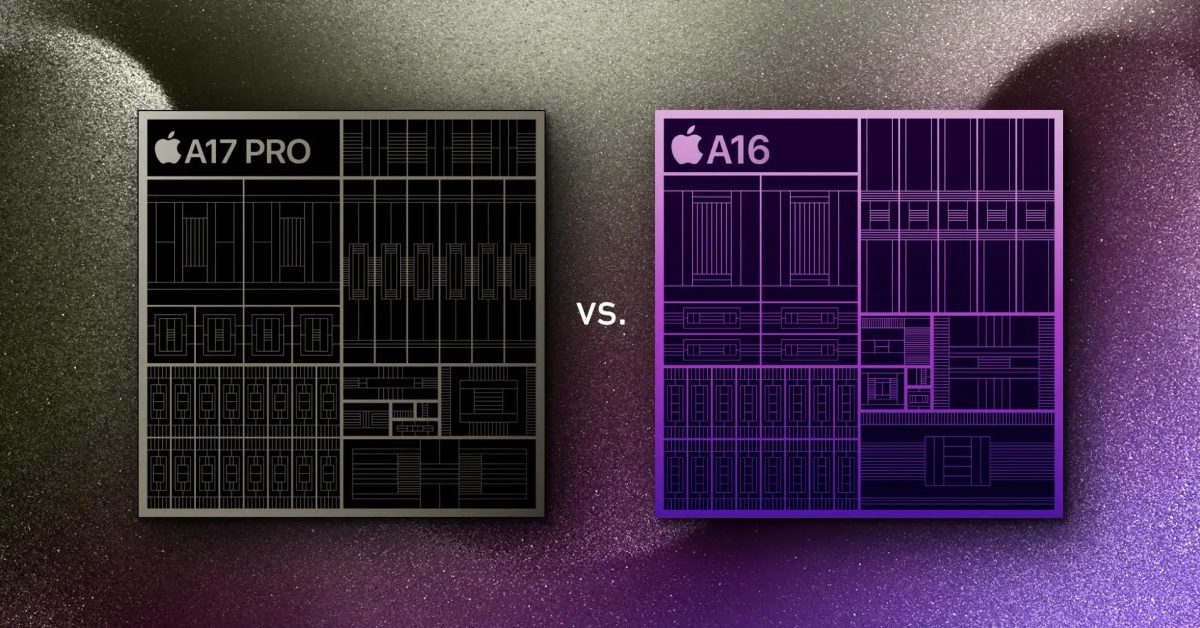
Apple’s A-series chips are at the core of its iPhone lineup, driving performance and efficiency. With the introduction of the A17 Pro in the iPhone 15 Pro models, a significant leap in technology was observed compared to the A16 Bionic, which powers the iPhone 14 Pro series and the standard iPhone 15 models. This comparison delves into the architectural and performance distinctions between these two formidable mobile processors.
A17 Pro: The Next Generation
The A17 Pro chip, exclusive to the iPhone 15 Pro and iPhone 15 Pro Max, marks a significant milestone as the industry’s first 3-nanometer chip. This smaller process node allows for more transistors in a compact space, leading to improved performance and power efficiency. It features a 6-core CPU, comprising two high-performance cores and four high-efficiency cores, alongside a 6-core GPU. A key enhancement is its 16-core Neural Engine, which is twice as fast as its predecessor.
A16 Bionic: Still a Powerhouse
The A16 Bionic chip, found in the iPhone 14 Pro, iPhone 14 Pro Max, iPhone 15, and iPhone 15 Plus, is built on a 4-nanometer process. It also features a 6-core CPU with two performance cores and four efficiency cores. Its GPU is a 5-core design, and it includes a 16-core Neural Engine, which, while powerful, operates at half the speed of the A17 Pro’s Neural Engine.
CPU Performance: Incremental Gains
When comparing the CPUs, the A17 Pro offers a modest but noticeable improvement over the A16 Bionic. Benchmarks typically show the A17 Pro’s single-core performance to be approximately 10% faster than the A16 Bionic. Multi-core performance also sees a similar gain, indicating a general uplift in raw processing power for everyday tasks and demanding applications.
GPU Performance: A More Significant Leap
The A17 Pro’s 6-core GPU delivers a more substantial performance boost, estimated to be around 20% faster than the A16 Bionic’s 5-core GPU. A standout feature of the A17 Pro’s GPU is its hardware-accelerated ray tracing capabilities. This technology enables more realistic lighting, reflections, and shadows in games and graphics-intensive applications, providing a console-like gaming experience on a mobile device. The A16 Bionic relies on software-based ray tracing, which is less efficient and performs slower.
Neural Engine and Apple Intelligence
Both chips feature a 16-core Neural Engine, but their capabilities differ significantly. The A17 Pro’s Neural Engine can perform up to 35 trillion operations per second (TOPS), a dramatic increase from the A16 Bionic’s 17 TOPS. This enhanced processing power for machine learning tasks is crucial for Apple Intelligence, the company’s new personal intelligence system. While the A16 Bionic is also capable of running Apple Intelligence, the A17 Pro’s faster Neural Engine allows for more efficient and quicker on-device processing of AI features, leading to a smoother and more responsive user experience.
Efficiency and Battery Life
The 3-nanometer process of the A17 Pro inherently contributes to better power efficiency. This means the chip can achieve higher performance levels while consuming less power, potentially leading to improved battery life or sustained performance under heavy loads compared to the A16 Bionic. The A17 Pro also introduces a dedicated USB 3 controller, enabling significantly faster data transfer speeds through the USB-C port on the iPhone 15 Pro models, a feature not present on the A16 Bionic-equipped devices.

Summary of Key Differences
- Process Technology: A17 Pro (3nm) vs. A16 Bionic (4nm)
- CPU Speed: A17 Pro offers ~10% faster single and multi-core performance.
- GPU Speed: A17 Pro is ~20% faster with hardware-accelerated ray tracing.
- Neural Engine: A17 Pro is twice as fast (35 TOPS vs. 17 TOPS), crucial for Apple Intelligence.
- Connectivity: A17 Pro includes a USB 3 controller for faster data transfer.
In conclusion, while the A16 Bionic remains a highly capable chip, the A17 Pro represents a substantial upgrade, particularly in graphics performance, AI processing, and overall efficiency. These advancements make the iPhone 15 Pro models exceptionally powerful, especially for demanding applications, advanced gaming, and the upcoming Apple Intelligence features.
