


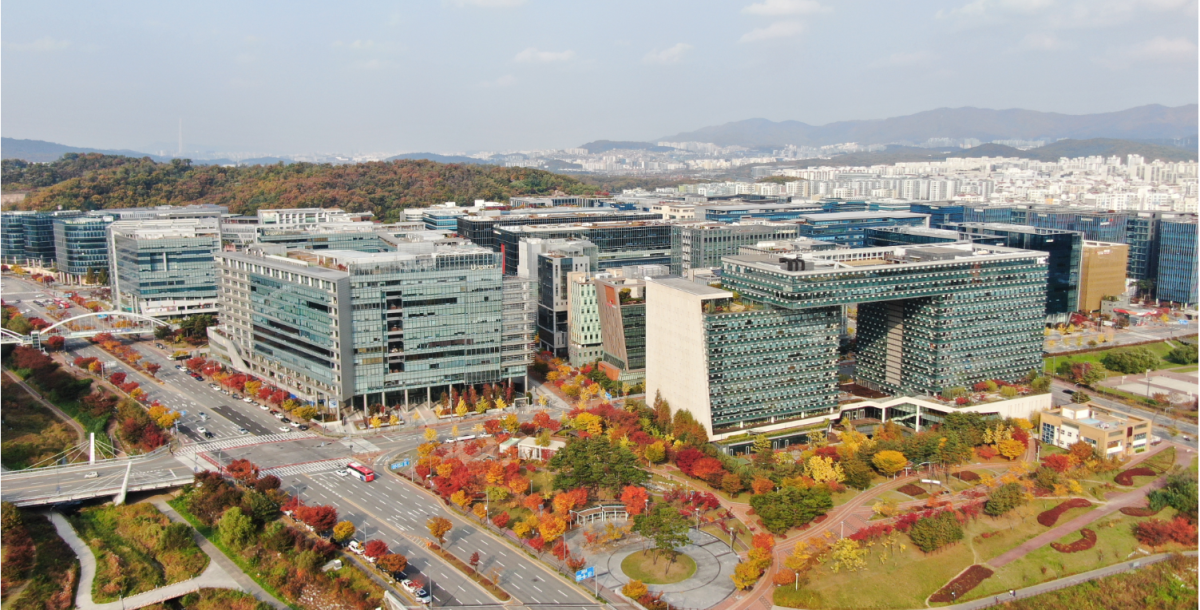
Pangyo Techno Valley (PTV), located in Seongnam, just south of Seoul, is often referred to as South Korea’s “Silicon Valley.” This extensive tech complex is a mere 15-minute subway journey from Gangnam, an area renowned for its luxury shops, K-pop entertainment, and vibrant nightlife in Seoul.
Established in 2011, this 661,000-square-meter development has become a key innovation center in South Korea. It hosts over 1,800 startups, research facilities, and international tech companies, creating an environment that resembles a futuristic laboratory rather than a typical Seoul suburb.
Pangyo Techno Valley is home to prominent companies such as Naver, often called Korea’s Google, and Kakao, the nation’s dominant “everything app.” Gaming leaders Nexon and NCSoft are also present, alongside industrial giants like HD Hyundai and cybersecurity firm AhnLab. Samsung Electronics, SK Hynix, and Hyundai’s 42dot autonomous vehicle division also have substantial operations. However, despite this impressive collection of tech talent and investment, some industry observers doubt if Pangyo genuinely lives up to its “Silicon Valley” moniker.
Hyoungchul Choi, CEO of Portlogics, who established his company in Pangyo five years ago, acknowledges that Pangyo is “absolutely Korea’s most concentrated hub for software, gaming, platforms, and AI.” However, he expresses skepticism about the “Silicon Valley” comparison. He states that while the nickname is convenient, Pangyo’s global influence should not be overstated. Choi emphasizes that Silicon Valley’s identity stems from decades of international capital, a culture of risk-taking, and its capacity to draw global talent, aspects he believes Pangyo has not yet fully achieved.
This more conservative evaluation is supported by data. A year ago, Pangyo Techno Valley primarily housed smaller entities, with about 91.5% of its businesses being small and midsize. Big Tech firms constituted only 3.6%, and public or government organizations made up the remaining 4.9%, as reported on PTV’s official website.
Janice Sa, a principal at Z Venture Capital with over a decade of experience in Pangyo, observes a decline in the district’s overall influence.
Sa acknowledges that the presence of major companies like Kakao, Naver, Nexon, and NCSoft still justifies Pangyo’s “Korea’s Silicon Valley” title. However, she notes that the district’s dominance as the nation’s primary tech hub has diminished compared to a decade ago. Previously, startups eagerly moved to Pangyo, but now many are returning to Gangnam in Seoul. Sa attributes this shift to factors like talent and capital. She explains that young developers and engineers prefer Gangnam, and most venture capital firms are concentrated on Teheran Street, Seoul’s central tech corridor, which is populated by startups, large tech offices, and investors. This concentration makes Gangnam a more convenient option for recruitment and fundraising.
This migration of startups highlights a larger issue. Sa points out that large corporations with long-term leases and tax incentives face fewer problems operating in Pangyo. However, for startups vying for talent, the location presents a greater hurdle. Despite its proximity to Gangnam, Pangyo remains in Gyeonggi Province, not Seoul. Government support programs are frequently linked to local jurisdictions, which results in Seoul having more robust startup infrastructure and more effective global initiatives.
An anonymous insider from a Pangyo-based tech company echoed these sentiments. The concentration of tech firms in Pangyo has fostered a culture inherently suited to the industry. The insider noted that “When working in tech here, collaboration is simpler — everyone is nearby.” However, Seoul offers greater diversity, with areas like Yeouido serving as Korea’s financial hub, ideal for fintech companies, and Gangnam attracting a wide array of startups.
A more significant concern is the ability of Korean startups to compete on a global scale, irrespective of their location. Both government and private investors are encouraging companies to pursue international expansion due to a saturated domestic market. Despite these efforts, significant global success stories have been rare.
An investor from Kakao Ventures points to cultural distinctions as a potential reason for this disparity. The investor observed that “American startups typically experience success — and failure — at a much quicker pace, fostering continuous experimentation and frequent talent mobility. Speed is a startup’s primary asset, so discussions with founders often focus on transforming failures into opportunities.”
This investor also identifies storytelling as a hurdle. They noted that “While many Korean founders excel in numbers and strategy, they often struggle with a fundamental question: What is your story? Business fundamentally involves human connection. Without a distinct, genuine narrative explaining why a founder and their team are the ideal choice, it is difficult to differentiate. Given that many already possess strong skills, this personal story becomes even more crucial.”
Despite the obstacles, Choi remains optimistic. He describes the environment as a mix of ambitious founders and the stable presence of large Korean tech firms, where job security and benefits are highly valued. Choi explains that “In contrast to the U.S., where founders frequently embrace risk and pivot quickly, startups in Korea typically balance ambition with careful planning, establishing domestic proof before venturing internationally. This approach results in reliable engineering but lacks the ‘move fast, break things’ ethos characteristic of Silicon Valley.”
Choi also noted that Pangyo is expanding its focus beyond gaming and platforms, venturing into AI, biotech, and deep tech, supported by government investments in startup campuses and scaling initiatives.
According to Choi, the true challenge now lies not in local expansion, but in demonstrating global success through the emergence of unicorns, international acquisitions, and consistent talent attraction.
Choi identified three primary barriers preventing Korean startups from achieving global reach: the limited size of the domestic market, weaker connections with global investors, and linguistic or regulatory obstacles that introduce further complications. He emphasized that overcoming these challenges requires more than just ambition; it demands early global partnerships, strategic go-to-market resources, and leaders who adopt a cross-border mindset from the outset.
However, a fourth element—the capacity of these startups to convey compelling narratives globally—might be the most critical factor in determining whether they remain a regional tech hub or evolve into a genuine global innovation center.
