


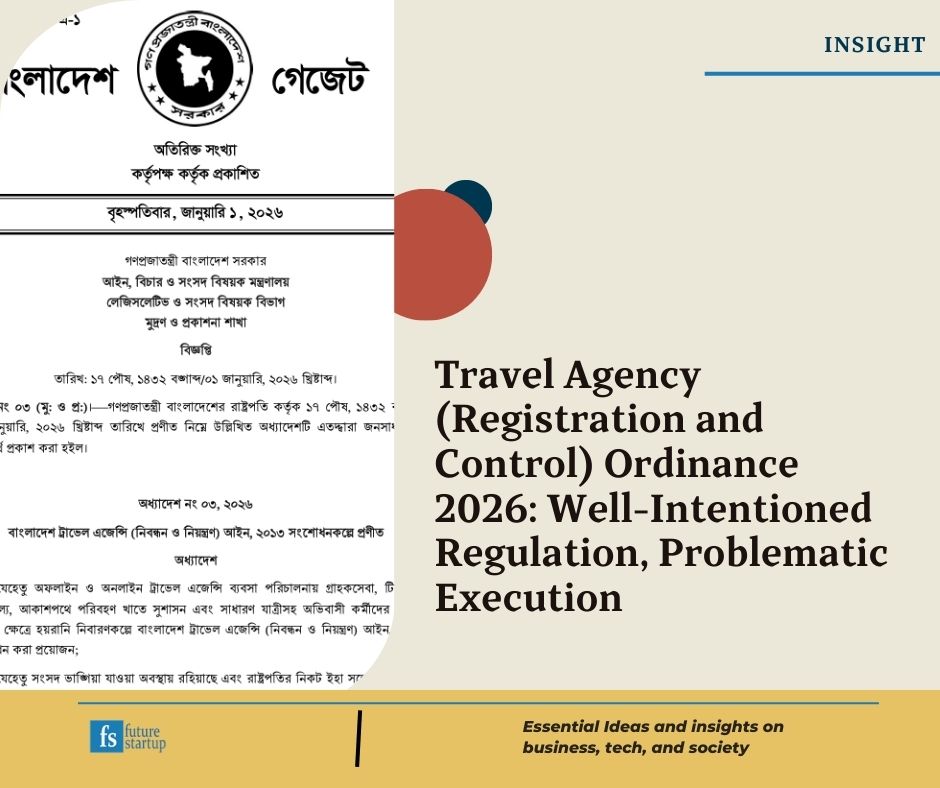
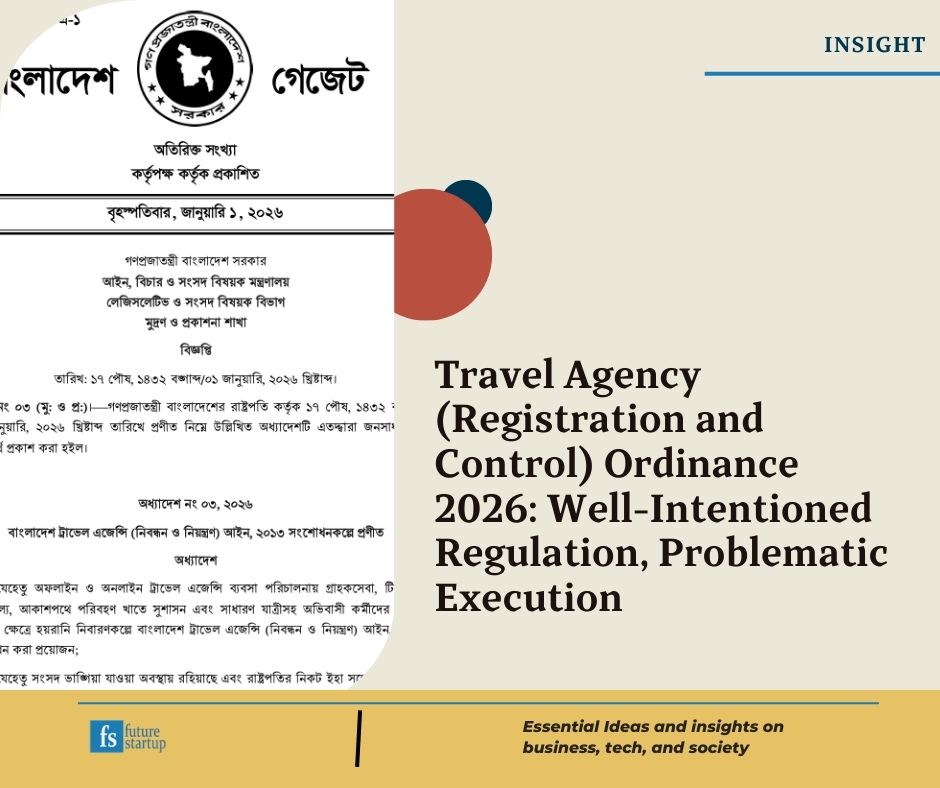
 On January 1, 2026, the Bangladeshi government introduced amendments to the Travel Agencies (Registration and Control) Ordinance, 2026. This presidential order follows the collapse of at least three online travel agencies between 2024 and 2025, which reportedly defrauded customers of substantial sums in ticket payments. A draft of these amendments had previously been released for stakeholder feedback.
The new regulations are extensive, covering beneficial ownership transparency, fraudulent bookings, unclear pricing, and financial assurances. While these issues are valid, the ordinance reflects a common trend in Bangladesh’s regulatory development: well-intentioned rules that impose standards suitable for large, well-funded businesses onto a market primarily composed of small, financially limited operators.
This approach is likely to lead to market consolidation, the departure of smaller businesses, and increased obstacles to innovation. The effectiveness of this policy depends on its ultimate objectives.
What the Ordinance Includes
The amendments update the Bangladesh Travel Agency (Registration and Control) Act, 2013. Their stated goals are to “ensure customer service, fair pricing, good governance in the aviation transport sector and to prevent harassment of passengers”. Key provisions are:
- Ultimate Beneficial Ownership (UBO) disclosure: The ordinance mandates identifying the natural persons who ultimately own or control travel agencies, irrespective of their corporate structure. This aims to prevent the common practice of concealing true ownership through shell companies or nominee arrangements. For instance, when Flight Expert reportedly disappeared with customer funds, authorities faced difficulty in identifying the actual owners. UBO disclosure directly addresses this issue.
- B2B transaction restrictions: Section 7 now stipulates that travel agencies selling tickets to other agencies must conduct these transactions at “arm’s length,” meaning at market-rate pricing without preferential treatment for related parties. This provision targets the prevalent sub-agent model in Bangladesh’s travel market. Out of approximately 5,000-5,200 licensed agencies, only about 1,300 possess IATA accreditation. The remaining 3,700+ function as sub-agents, purchasing tickets from IATA agencies for resale to customers. The arm’s length requirement significantly complicates this model, necessitating documentation and justification for each B2B transaction.
- Technical infrastructure requirements: Travel agencies are now required to maintain direct connections with airlines through Global Distribution Systems (GDS) or New Distribution Capability (NDC) platforms, provide airlines with accurate real-time passenger information, and make consolidated payments to airlines for all booked tickets. Industry estimates suggest GDS connectivity can cost Tk 5-10 lakh annually for smaller operations. Consolidated payments demand working capital often unavailable to most sub-agents. These stipulations effectively establish a minimum operational scale for businesses.
- Prohibited practices: The ordinance explicitly forbids false bookings, placeholder reservations without confirmed payment, using multiple identities to avoid penalties, misleading pricing through deceptive promotional advertisements, and the unauthorized sharing of airline ticketing system login credentials. Violations can result in penalties of up to one year’s imprisonment and fines of up to Tk 10 lakh.
- Bank guarantee requirements: Online travel agencies are mandated to provide bank guarantees of Tk 1 crore (approximately $85,000), whereas offline agencies require Tk 10 lakh (approximately $8,500). The Ministry justified the higher amount for online agencies due to their “higher volume of transactions and greater financial risk associated with advance payments.” These guarantees must be continuously maintained; a lapse can lead to license suspension.
- Enhanced enforcement powers: Authorities now possess the power to immediately suspend licenses for severe violations without a prior hearing, permanently revoke licenses for repeated offenses, and, in collaboration with the Ministry of Home Affairs, impose travel bans on agency owners to prevent sudden departures. UBO disclosure facilitates enforcement across corporate structures. Registration certificates will be renewed every three years, contingent on compliance reviews.
Positive Aspects of the Ordinance
The ordinance effectively addresses genuine issues within Bangladesh’s travel market. UBO disclosure enhances accountability in an industry where corporate structures frequently obscure true ownership. The ban on false bookings safeguards both airlines, which require accurate inventory management, and customers, who need booking certainty. Requirements for consolidated payments prevent agencies from using customer funds as operational capital, a practice that contributed to several agency failures.
These provisions tackle real-world problems. The collapses of Flight Expert, Fly Far International, and Travel Business Portal involved precisely the practices targeted by this ordinance: unclear ownership, speculative bookings, delayed airline payments, and misuse of customer funds.
However, the bank guarantee requirement for online travel agencies highlights a fundamental flaw in the ordinance: it imposes standards suitable for large, sophisticated markets onto a developing one.
From an economic perspective, a new online travel agency might generate Tk 50 lakh to Tk 1 crore in bookings during its first year. With commissions ranging from 3-7% on airline tickets and 10-15% on hotel bookings, monthly gross revenue could be Tk 5-10 lakh. After operating costs, net margins in the first year are often negative. The Tk one crore is not an expense but a continuous guarantee, representing capital that cannot be used for operations.
Banks typically demand collateral for guarantees, often a 100-110% cash deposit or equivalent fixed assets. This effectively means entrepreneurs need over Tk one crore in liquid assets or property, thereby restricting OTA licenses to those who are already wealthy or venture-funded.
Comparing this internationally reveals a stark contrast. Bangladesh’s capital requirement is approximately 24 times higher than India’s, despite a similar GDP per capita. India requires ₹3 lakh (around $3,600) in paid-up capital with no additional bank guarantee beyond demonstrating this capital. Singapore, with a GDP per capita 34 times higher than Bangladesh’s, requires S$50,000-100,000 (around $37,000-74,000) as paid-up capital that can be utilized for business operations, not a locked-away guarantee. The UK’s ATOL scheme mandates bonds scaled to business size, starting at £50,000 (around $63,000) for small businesses, with alternatives like joining accredited bodies that can eliminate bond requirements.
Such high capital requirements do more than just exclude some entrepreneurs; they fundamentally alter market entry and the viability of business models. Established players like ShareTrip or GoZayaan, having secured venture funding, can meet this requirement. However, emerging founders, perhaps developing AI-powered travel planning, niche marketplaces, or accessibility-focused services, face an insurmountable barrier before they can even test their concepts.
Modern startup methodologies emphasize validated learning: building minimum viable products, testing with customers, and iterating based on feedback. A Tk one crore guarantee forces entrepreneurs to commit substantial capital before validating their business model, hindering the lean experimentation that often leads to innovative solutions.
Areas Where the Ordinance Falls Short
In addition to the capital requirement, the ordinance contains several structural issues that may limit its effectiveness and lead to unforeseen consequences.
- No transition period: The ordinance implements extensive requirements immediately, lacking any phased introduction or transition mechanisms. Travel industry leaders had specifically requested a transitional period for agencies to achieve compliance. In a market where 80-90% of transactions still occur offline through traditional agencies, many operators lack the necessary capital, technical capabilities, or institutional knowledge for rapid compliance. A 12-18 month transition period with defined milestones could achieve the same objectives while mitigating severe market disruption. Such a period could involve focusing on UBO disclosure and basic transparency in phase one, financial requirements in phase two, and full technical compliance in phase three. Instead, the current “comply-or-exit” approach may unnecessarily force many viable businesses to close.
- One-size-fits-all approach: The ordinance applies uniform standards to all travel agencies, from a small two-person sub-agency in Sylhet to a large, established operator. Small agencies cater to distinct market segments, employ different business models, and present varying risk profiles compared to large online travel agencies (OTAs). A sub-agency generating Tk 20-30 lakh in annual revenue from local customers does not pose the same systemic risk as an OTA or large agency managing crores monthly. A more effective regulatory framework would establish tiers based on transaction volume or revenue, aligning requirements with actual risk. Micro agencies could have lower guarantee requirements (e.g., Tk 2-3 lakh) and utilize GDS access provided by associations instead of direct contracts. Medium agencies could adhere to standard requirements, while large agencies and OTAs would face increased oversight proportional to their systemic significance.
- B2B restrictions eliminate legitimate intermediation: The requirement for arm’s length transactions in B2B sales effectively bans the sub-agent model. However, sub-agents fulfill a valid economic role by providing local presence in markets too small for direct IATA agency service, managing customer relationship costs that larger agencies prefer to avoid, offering credit to customers without online booking capabilities, and providing essential language and local expertise. Instead of prohibiting B2B sales, the ordinance could regulate them appropriately. This might involve requiring disclosure so customers are aware they are dealing with intermediaries, mandating transparency regarding base fares and markups, establishing accountability by making suppliers jointly liable for sub-agent misconduct, and setting commission caps to prevent exploitative markups while allowing fair margins. Such an approach would address actual issues like opacity and exploitation without dismantling a functional market structure.
- Enforcement mechanisms remain unclear: The ordinance outlines agency obligations but lacks clarity on how authorities will verify compliance or what enforcement capabilities are in place. Bangladesh has over 5,000 licensed agencies nationwide. The Ministry of Civil Aviation’s enforcement capacity is uncertain but likely insufficient for thorough oversight. Without clear enforcement mechanisms, including technology-enabled compliance monitoring, defined inspection schedules, standardized penalty structures, and sufficient inspector staffing, regulation risks becoming arbitrary. This could lead to enforcement targeting those who attract attention or lack connections, while others operate without consequence. The ordinance would benefit from incorporating mandatory integration with a central reporting system for all ticket issuances, real-time transaction monitoring to identify anomalies, automated alerts for suspicious patterns, published criteria for priority enforcement, and dedicated budget allocation for hiring and training inspectors.
Recommended Adjustments
While the ordinance is now law, its regulation should be adaptable. Three categories of changes could address its most significant deficiencies:
- Immediate adjustments: Implement a 12-month transition period with phased requirements and clear deadlines for each category. Introduce a tiered licensing structure based on annual revenue or transaction volume, with distinct requirements for micro, small, medium, and large agencies. Consider establishing a central, publicly accessible, and mobile-friendly compliance portal. This portal could allow customers to verify licenses, agencies to submit UBO disclosures, and complaints to be filed.
- Medium-term reforms: Create a regulatory sandbox framework to permit experimental licenses for innovative business models. This framework should include clear limits on transaction volumes and duration, alongside enhanced reporting requirements during the testing phase. Revise B2B transaction rules to shift from prohibition to transparency. This would allow sub-agents to operate if they clearly identify themselves to customers, disclose pricing breakdowns, accept joint liability with their suppliers, and adhere to reasonable commission caps.
- Structural improvements: Implement technology-enabled monitoring by requiring all agencies to integrate with a central transaction reporting system. This system should incorporate analytics to detect fraud patterns and generate automated alerts. Enhance enforcement capacity by allocating necessary resources and establishing partnerships with the Bangladesh Bank and BTRC for data sharing. Commit to an annual review of requirements, informed by implementation experience and formal feedback from agencies and customers. This process should include publishing enforcement outcomes data and adjusting thresholds based on evidence rather than assumptions. Bank guarantees should be scaled according to business size, and alternative options such as insurance policies, trust accounts, or association guarantee schemes should be permitted. A crucial reform involves re-evaluating the Tk one crore guarantee for online agencies. A more logical approach would link bond requirements to actual business size, based on annual revenue or booking volume: a startup tier (annual bookings under Tk 50 lakh) could require a Tk 5 lakh guarantee; a growth tier (Tk 50 lakh to 5 crore) a Tk 25 lakh guarantee; and an established tier (over Tk 5 crore) a Tk 1 crore guarantee. This method would provide consumer protection proportionate to risk while fostering innovation and market entry.
Market Implications
In its current form, the ordinance is expected to accelerate consolidation within Bangladesh’s travel market. While this trend was already underway—with digital platforms gaining traction, larger agencies acquiring smaller ones, and commission pressures impacting margins—the new regulatory requirements will significantly hasten this process.
As former ATAB president Manzur Morshed Mahbub cautioned, the amended provisions could severely affect nearly 5,000 non-IATA agencies. Drawing parallels from similar regulatory tightening in other sectors, it is anticipated that 30-50% of sub-agents may exit the market within 18-24 months of the ordinance’s effective enforcement. Some will cease operations voluntarily, while others might continue in an unregulated “gray market,” hoping for lax enforcement.
Remaining businesses will likely consolidate around larger agencies through franchise models, white-label platforms, or direct acquisitions. Large IATA-accredited agencies can now provide smaller operators with access to GDS connectivity, payment processing, and compliance infrastructure, effectively integrating them as distribution nodes within a broader network. The value captured by small agencies is expected to decrease, as they will operate on commissions set by the platform rather than their own markups.
For online travel agencies, the ordinance presents both opportunities and challenges. Companies like ShareTrip and GoZayaan already possess the necessary infrastructure. They can distribute compliance costs across high transaction volumes, achieving lower per-unit costs than traditional agencies. However, they also face the Tk one crore guarantee requirement and increased regulatory scrutiny. The primary beneficiaries might be large IATA agencies capable of adapting to offer B2B infrastructure to smaller agencies while simultaneously developing their own online capabilities.
Consumer outcomes are likely to be varied. Affluent urban customers who book online or through established agencies will benefit from improved transparency, bank guarantees, and stricter oversight.
Conversely, customers in secondary cities who depend on local agents may experience reduced access if those agents exit the market.
Price-sensitive customers, who previously benefited from competition among numerous players, will likely encounter higher prices as the market consolidates and remaining players gain pricing power.
Conclusion
The travel ordinance illustrates Bangladesh’s typical approach to business regulation in the digital age. This pattern consistently involves waiting for market failures, then responding with broad regulations that address multiple issues simultaneously, imposing requirements that assume significant scale and sophistication, and often leaving enforcement details somewhat vague. This frequently leads to unforeseen secondary consequences, creates barriers for new market entrants, favors established businesses, stifles innovation and competition, and can ultimately result in poorer service for customers.
This contrasts with other regulatory models. Singapore, for example, regulates proactively and precisely, using clear cost-benefit analyses and often employing regulatory sandboxes for new business models. India tends to allow markets to develop more freely, regulating reactively, but maintains flexibility for innovation and acknowledges limitations in enforcement capacity. China regulates strictly but pragmatically, with an overarching goal of fostering national champions.
Bangladesh’s method combines ambitious regulation with insufficient enforcement capacity and a lack of strategic industrial policy. The outcome is often regulations that appear sound on paper but face significant implementation challenges, creating strategic uncertainty for entrepreneurs and investors.
Ignoring regulations is not an option due to real penalties, yet assuming perfect enforcement is also unrealistic given capacity constraints. The most effective strategy thus becomes a combination of compliance and cultivating regulatory relationships, which inherently benefits those with capital and connections.
As Bangladesh’s digital economy expands across sectors like e-commerce, fintech, logistics, and healthcare technology, similar regulatory questions will emerge. The challenge for policymakers lies in calibrating regulations to market maturity. In nascent markets with low penetration and substantial growth potential, an optimal regulatory strategy might prioritize core consumer protection while allowing flexibility for business model innovation. Prematurely comprehensive regulation can inadvertently halt innovation, preventing the development of superior solutions.
The Bangladesh Travel Agency Ordinance 2026 addresses legitimate problems using valid policy instruments. Provisions such as UBO disclosure, the prohibition of false bookings, and consolidated payment requirements all serve important objectives. The government’s concern for consumer protection following major agency collapses is entirely justified.
However, the ordinance also demonstrates how well-intentioned regulation can produce unintended consequences when its requirements are not appropriately aligned with market realities.
A more refined approach would safeguard consumers while fostering innovation and competition. This would include transition periods for adaptation, tiered requirements proportionate to actual risk, scaled guarantees based on business size, regulatory sandboxes for experimentation, and technology-driven monitoring instead of solely relying on upfront capital barriers.
Fortunately, regulations can evolve. The key question is whether policymakers will adopt an iterative approach, adjusting based on implementation experience and evidence, or a defensive stance that views any change as an admission of error.
For entrepreneurs, investors, and agencies operating in this environment, the strategy is clear: comply where feasible, advocate for rational changes, build resilient business models, and recognize that regulatory evolution is an integral part of the competitive landscape. The travel market is set for consolidation. Some agencies will exit, while others will thrive. The ordinance accelerates existing trends. Those who understand and adapt to these changes will discover opportunities, whereas those who resist or hope for the continuation of the old system will struggle. Ultimately, effective execution, adaptation, and strategic clarity remain paramount.
