


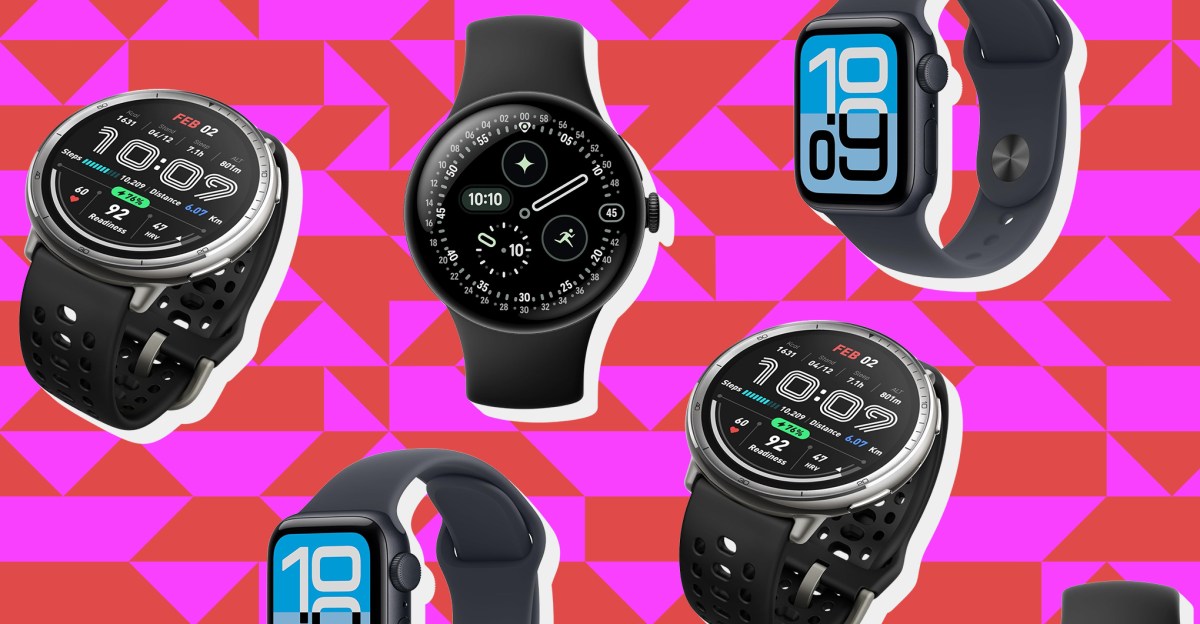
Fitness trackers have evolved significantly from basic step counters. Today’s devices can monitor various aspects of health, from heart activity to recovery post-training. Even advanced smartwatches, once limited in fitness capabilities, now serve as capable workout partners. Regardless of individual fitness aspirations, a suitable tracker likely exists to support those goals.
Wearable technology is highly personal, requiring careful consideration before purchase. It is challenging to declare a single fitness tracker as universally superior. Fortunately, the market in 2026 offers a wide array of fitness trackers to suit diverse lifestyles and needs.

Featured Products


Amazfit Active 2
Garmin Venu Sq 2
Oura Ring 4
Samsung Galaxy Watch Ultra
Google Pixel Watch 4
Apple Watch SE 3
Garmin Fenix 8
What to Look For in a Fitness Tracker
How Fitness Trackers Are Tested
Fitness trackers aim to help users monitor their health and activity. Testing involves a combination of benchmark and real-world scenarios, including wearing devices during sleep, GPS-tracked activities like runs and hikes, and various workouts. Performance is compared against long-term control devices for heart rate, sleep, and GPS accuracy. Key factors considered in rankings include durability, overall performance, consistency in metrics (rather than just accuracy), and battery life.
Audience
Consider the target user for each fitness tracker. The ideal device for dedicated athletes will differ significantly from one suited for casual users seeking to increase their daily steps.
Battery Life
A fitness tracker should ideally offer at least two to three days of battery life between charges. Flagship smartwatches should, at minimum, provide efficient quick charging capabilities.
Form Factor
Evaluate whether the device is a band or a smartwatch, and its comfort for continuous 24/7 wear.
Metrics
Assess the metrics tracked by the device. Priority is given to active minutes over steps and calorie burn, with additional health metrics like resting heart rate, VO2 Max, and sleep quality being beneficial.
Consistency
While accuracy is valuable, consistent results for heart rate, distance tracking, and steps are more crucial for measuring progress over time.
Platform
Some trackers are tied to specific phone ecosystems, while others offer broader compatibility. Devices that work independently of a particular phone brand are generally preferred.
In This Article
- Best fitness tracker overall
- Best fitness watch for casual users
- Best for serious outdoor athletes
- Best non-wrist tracker
- Best fitness band
- Most stylish fitness watch
- Best fitness tracker for iPhone users
- Best fitness smartwatch for Samsung phones
- Best fitness smartwatch for Android
- Best for early adopters and elite athletes
- What’s coming next
Best Fitness Tracker Overall
Amazfit Active 2
Size: 43mm w/ 20mm straps / Weight: 29.5g for standard, 31.7g for premium / Battery life: Up to 10 days / Display type: OLED touchscreen / GPS: Five GNSS systems / Connectivity: Bluetooth, Wi-Fi / Water resistance: 5ATM / Music storage: N/A
The Amazfit Active 2 stands out as an excellent all-around fitness tracker. While smartwatches are becoming more advanced, the Active 2 maintains the core appeal of a traditional fitness tracker: an affordable price, comprehensive basic health features, a holistic tracking approach, and a comfortable yet stylish design. Priced at 99.99 for the standard version and 129.99 for the premium version with a leather band, it offers significant value.
Its hardware and design are surprisingly elegant for the cost. The standard model features a stainless steel case and tempered glass screen, while the premium version upgrades to sapphire crystal and includes an additional leather strap. The screen is bright at 2,000 nits, and the device provides an estimated 10 days of regular use on a single charge. During testing, power users might experience closer to eight or nine days. European users also benefit from NFC payments.

The Active 2 often receives compliments, which is rare for budget trackers.
Health features include continuous heart rate monitoring, blood oxygen rate, heart rate variability, stress tracking, alerts for abnormal heart rates, and skin temperature tracking. It also offers a daily readiness score and detailed sleep tracking for those interested in recovery metrics. An optional Zepp Aura AI chatbot is available for more in-depth recovery insights at an additional yearly cost. For workouts, it supports 160 different sport types, including HYROX and a strength training mode with automatic rep counting. The Active 2 also features offline maps, turn-by-turn directions, connectivity to third-party peripherals, and Zepp Coach, an AI-powered coach that generates custom training plans. Built-in GPS with five satellite systems is also included.
Minor drawbacks include a touchscreen that can be difficult to use with sweaty fingers and an onboard AI assistant that sometimes requires clear enunciation for voice commands. While it lacks advanced health features like EKGs and sleep apnea detection, these are not the primary focus of the Active 2. This device excels as a classic, fundamental fitness tracker that stylishly resembles a watch.
Read the full Amazfit Active 2 review.
Best Fitness Watch for Casual Users


Garmin Venu Sq 2
Sizes: 40mm w/ 20mm straps / Weight: 38g / Battery life: Up to 11 days / Display type: OLED touchscreen / GPS: All-systems GNSS / Connectivity: Bluetooth, Ant Plus / Water resistance: 5ATM / Music storage: 4GB (for Music Edition)
The Garmin Venu Sq 2, priced at $250, is a recommended alternative for users looking to upgrade from an older Fitbit Versa model. It offers a similar aesthetic and feel, but with a superior OLED display and extended battery life.
Garmin is renowned for its extensive fitness tracking capabilities, and this device is no exception. Beyond basic step and calorie tracking, it provides much more. Features include built-in GPS for tracking walks, runs, and bike rides, along with numerous other sport profiles like yoga and strength training. Smart features encompass push notifications, timers, contactless payments, and safety features such as Garmin’s Incident Detection, which functions similarly to fall detection. However, a phone must be carried for these features, as the Venu Sq 2 does not have LTE connectivity.

The Garmin Venu Sq 2 features a bright, attractive OLED display and impressive battery life.
For an additional $50, the Music Edition offers onboard music storage for approximately 500 songs. However, this upgrade may not be essential, as users will likely have their phone nearby given the watch’s reliance on it for certain functions.
A notable advantage of this watch is its potential for user growth. In addition to recovery metrics and sleep tracking, it includes Garmin Coach, a free, integrated training program for beginner and intermediate runners aiming for 5K, 10K, or half marathon goals. For health tracking, it monitors heart rate, blood oxygen, intensity minutes (weekly moderate exercise), stress, hydration, respiratory rate, and menstrual cycles. All these data features are accessible without a paywall. However, Garmin introduced a premium tier last year for $6.99 a month (or $69.99 annually), offering personalized AI-powered insights and additional features.
It is worth noting that Garmin has since released the Venu 3 and Venu 4, which include an updated heart rate sensor, nap detection, and, for the Venu 4, the ability to view health metrics directly on the watch face. While the Venu 3 was well-received, its $449.99 price point makes it less ideal for casual users, and the Venu 4 is even more expensive at $549.99. Another option is Garmin’s Forerunner 165, a $249 budget training watch that shares many features with the Venu Sq 2 but has a sportier design.
Ultimately, choosing a device within one’s budget is key. Older models remain viable options for basic fitness tracking, especially since Garmin often extends newer software updates to older hardware, and users tend to keep their Garmin devices for extended periods.
Read the full Garmin Venu Sq 2 review.
Best for Serious Outdoor Athletes


Garmin Fenix 8
Sizes: 43mm w/ 20mm straps; 7: 47mm w/ 22mm straps; 7X: 51mm w/ 26mm straps / Weight: 60g (43mm), 73g (47mm), 92g (51mm)/ Battery life: Up to 10 days (43mm), 16 days (47mm), 29 days (51mm) Display type: MIP or OLED / GPS: All-systems GNSS and dual-frequency GPS / Connectivity: Bluetooth, Wi-Fi / Water resistance: 10ATM / Music storage: Up to 32GB
The Garmin Fenix 8 combines the aesthetic appeal of the Apple Watch Ultra and Galaxy Watch Ultra with enhanced smart features. This watch boasts a circular OLED display protected by Gorilla Glass or sapphire crystal, a stainless steel or titanium bezel, and a battery life of up to 26 days, depending on the size. These materials are comparable to those used in high-end smartwatches from Apple and Samsung, but the Fenix 8 distinguishes itself with its circular form factor. Its predecessor lacked many of the welcome smart features now included.
The smartwatch incorporates a built-in microphone and speaker, enabling users to take calls. Its smart voice assistant can be used to set timers, initiate activities, or access a phone’s assistant for more complex tasks. However, the watch’s smart capabilities are somewhat limited by the absence of LTE, meaning some features, including call functionality, rely on a Bluetooth connection to a phone. This is less of an issue at home but can be frustrating for users who wish to remain connected during phone-free outdoor activities. Cellular connectivity is available on the Fenix 8 Pro, which starts at $1,199.99.
The primary reason to choose the Fenix 8 over other premium smartwatches is its extensive array of fitness features. The free, integrated Garmin Coach provides running, cycling, and strength training plans, which adapt based on collected health data and workout performance. It also suggests daily workouts, estimates recovery time, and calculates recommended pace times for long races using GPS data. The device can even assess the physical impact of a run and recommend a mileage cap to prevent overexertion.
This smartwatch records activity, heart rate, and sleep (including naps), using this information to generate a daily health and wellness summary each morning. An evening report suggests optimal sleep duration and provides details about upcoming workouts. For travelers, the Fenix 8 can offer advice on adjusting sleep schedules and exercise routines. These features are designed to aid in race preparation, while the smart features enhance the watch’s utility beyond athletic pursuits.
Read the full Garmin Fenix 8 review.
Best Non-Wrist Tracker


Oura Ring 4
Sizes: 12 proprietary sizes, 4–15, sizing kit needed / Weight: 4–6g (depends on size) / Battery life: Up to seven days / Display type: None / GPS: None / Connectivity: Bluetooth / Water resistance: Up to 328 feet / Music storage: None
While most fitness trackers are worn on the wrist, the $349 Oura Ring offers a discreet alternative. This smart ring is an excellent choice for individuals seeking a less obtrusive device. Its lack of a screen and absence of mirrored phone notifications also make it less distracting than many wrist-based options.
The Oura Ring 4 does not significantly differ in functionality from the previous Gen 3. It features a slimmer, all-titanium design, improved battery life, and an updated sensor algorithm that Oura claims offers greater accuracy. None of these software enhancements are exclusive to the Ring 4, so Gen 3 owners may not need to upgrade unless their current ring’s battery life has significantly diminished. However, the fourth-generation model introduces an expanded size range from 4 to 15, potentially offering a better fit for those who struggled with Gen 3 sizing.

The Oura Ring 4 is available in an expanded size range, from 4 to 15.
Despite its compact size, the Oura Ring tracks a wide array of metrics, including heart rate variability, body temperature, blood oxygen, all-day heart rate monitoring, and cycle tracking. Since its launch, the Oura Ring has also incorporated activity tracking, blood oxygen levels, chronotypes for visualizing circadian rhythms, a social feature called Circles, enhanced stress tracking, and cardiovascular age and capacity metrics.
More recent additions include an AI chatbot, meal logging, and glucose tracking, though the latter requires purchasing a $99 Dexcom Stelo CGM. It has also rolled out a more accurate sleep stages algorithm, and the app has been completely redesigned to better organize these features and metrics. An update released last year improved step-tracking accuracy by utilizing an algorithm that more effectively detects movement as steps. The same update also enhanced calorie burn estimates by incorporating heart rate measurements to determine workout intensity.
The Oura Ring tracks standard metrics like steps and calories burned, but its primary focus is on sleep and recovery. Each day, users receive three scores for readiness, sleep, and activity, providing a straightforward, holistic overview of overall wellness. This makes it an ideal choice for those who prefer a more hands-off approach to their data. In October, Oura also announced Health Panels, a feature allowing users to schedule blood tests with local Quest Diagnostics. The results, encompassing dozens of cardiovascular and metabolic health biomarkers, can be viewed within the Oura app, and the company’s AI chatbot, Oura Advisor, can assist in interpreting them.
For Samsung Galaxy Watch owners, the $399.99 Galaxy Ring might be an alternative. While slightly more expensive than the base Oura Ring, it does not require a subscription and offers superior battery life when paired with a Galaxy Watch. The hardware, particularly the charging case, is also excellent. However, this option is exclusively for Android users, and its full potential is only unlocked when used with other Samsung devices.
While various other smart rings exist, the Oura Ring currently provides the most refined experience.
Read the full Oura Ring 4 review.
Best Fitness Band


Amazfit Band 7
Size: 42mm x 24mm x 12.2mm with 16mm straps / Weight: 28g / Battery life: Up to 18 days / Display type: OLED / GPS: Tethered / Connectivity: Bluetooth / Water resistance: 5ATM / Music storage: None
The Amazfit Band 7’s $49.99 price point is exceptionally competitive, often available for even less during sales. Wearing the Band 7 evokes a nostalgic feel reminiscent of earlier fitness trackers, making it ideal for those seeking a simple, casual, and budget-friendly device.
While the Band 7’s design may not be a standout feature, it offers several appealing watch faces that effectively utilize its OLED touchscreen. Despite having an OLED display, it still delivers approximately 14 days of battery life on a single charge. Its remarkably lightweight design also makes it a comfortable option for sleep tracking.

The Amazfit Band 7 may not be a head-turner, but it offers capable and affordable fitness tracking, a rarity in today’s market.
For its price, the device includes an impressive array of features, such as Amazon Alexa, continuous heart rate monitoring, blood oxygen monitoring, stress tracking, advanced sleep tracking, training metrics like VO2 max and load, abnormal heart rate alerts, menstrual tracking, push notifications, a “find my phone” function, a camera remote, and even a Pomodoro timer. While it lacks contactless payments and relies on tethered GPS, these are reasonable trade-offs given the extensive feature set. It may not be the optimal choice for intense fitness tracking, but it excels as a casual activity and step tracker.
Amazfit has consistently produced quality budget trackers. However, for those hesitant about a lesser-known brand, the $159.95 Fitbit Charge 6 presents a solid alternative. Although pricier, it offers features missing from the Amazfit, including access to Google services like YouTube Music, Google Wallet, and Google Maps. Additionally, it boasts built-in GPS and the ability to broadcast heart rate to compatible gym equipment via Bluetooth.
Read the full Amazfit Band 7 review.
Most Stylish Fitness Watch


Withings ScanWatch Light
Sizes: 37mm with 18mm straps / Weight: 45g / Battery life: Up to 39 days / Display type: OLED display / GPS: Tethered GPS / Connectivity: Bluetooth / Water resistance: 5ATM / Music storage: N/A
The $249.95 Withings ScanWatch Light is an attractive hybrid analog smartwatch, combining the elegance of a dress watch with fitness band functionalities and a touch of Swatch-like design. It covers essential features such as basic push notifications, timers, and alarms. Users can also track steps, sleep, menstrual cycles, and GPS activities directly from the wrist. Its stylish appearance is complemented by available minty green and pale blue color options for those who prefer a vibrant look. The device boasts exceptional battery life, with an estimated 30 days on a single charge. During testing, it achieved around 25 days, which still significantly surpasses most flagship smartwatches and offers a more fashionable alternative to bulkier multisport watches with similar battery endurance.
As its name implies, the Light is a simplified version of the $369.95 ScanWatch 2. The primary omissions are an EKG sensor for atrial fibrillation detection, a temperature sensor, blood oxygen tracking, and an altimeter for elevation monitoring. For basic fitness tracking, these advanced sensors are not strictly necessary, making the $100 savings on the Light a worthwhile trade-off. Both models lack safety features, contactless payments, and some other advanced functionalities found in watches within the $350 price range. However, for those desiring additional features, the ScanWatch 2 also offers a slightly more refined aesthetic due to its secondary step-counter dial.

The ScanWatch 2 is approximately $100 more expensive but includes more advanced health tracking capabilities.
Another appealing option is the $179.99 Garmin Vivomove Sport, which previously led this category. Its price is hard to beat, especially considering access to Garmin’s robust platform. However, the Vivomove Sport’s “hidden” OLED display can be difficult to read in bright light, and its battery life, at around five days, is considerably shorter than other hybrid analog watches. Nevertheless, if a fitness-focused platform is preferred over a wellness-oriented one, the Vivomove Sport might be a better choice than a Withings watch.
Read the full reviews of the Withings ScanWatch 2 and Light.
Best Fitness Tracker for iPhone Users


Apple Watch SE 3
Sizes: 40mm, 44mm / Weight: 26.3g (40mm), 32.9g (44mm) / Battery life: Up to 18 hours / Display type: Always-on LTPO OLED / GPS: Built-in GPS, plus GLONASS, Galileo, QZSS, Beidou / Connectivity: 5G (optional), Bluetooth, Wi-Fi / Water resistance: Up to 50 meters / Music storage: 64GB
The Apple Watch SE 3 unexpectedly emerged as Apple’s most compelling smartwatch of 2025. This latest entry-level smartwatch from Apple features an always-on display, which the company claims is more scratch-resistant than its predecessor. It also incorporates the same S10 chip found in the Apple Watch Series 11 and Apple Watch Ultra 3, though it lacks the Ultra Wideband chip present in those higher-end models. For the first time in the SE line, Apple has introduced fast charging, on-device Siri, its double tap and wrist flick gestures, and a built-in speaker. The cellular version of the Apple Watch SE 3 supports 5G, offering faster downloads and improved coverage.
These enhanced specifications make it challenging to recommend the more expensive Apple Watch Series 11, unless an EKG-capable smartwatch is a priority. However, the SE 3 can passively detect signs of atrial fibrillation through irregular heart rhythm notifications. It also provides sleep apnea notifications and more comprehensive period tracking. It cannot, however, record blood oxygen levels, a feature Apple recently reintroduced to various compatible Apple Watch models in the US after its removal in 2023 due to a copyright dispute.
The Apple Watch SE 3 was launched alongside WatchOS 26, which includes additional fitness and wellness features. Workout Buddy utilizes fitness data to provide personalized insights, advice, and motivational messages via a virtual assistant. This assistant reminds users of their goals and recent achievements, and summarizes workout results. WatchOS 26 is also compatible with the Apple Watch SE 2, Apple Watch Series 6 and newer, and all Apple Watch Ultra models.
One technical aspect Apple did not improve was battery life, with the SE 3 still offering approximately 18 hours per charge. In one test, which included a cross-country flight and a 48-minute mini-golf session, the watch retained 27 percent battery after about 13 hours of use without low power mode. The Apple Watch SE 3 is the recommended choice unless a larger screen, more sophisticated health tracking, or the ruggedness and multi-day battery life of the Apple Watch Ultra are essential.
Read the full Apple Watch SE 3 review.
Best Fitness Smartwatch for Samsung Phones


Samsung Galaxy Watch Ultra
Sizes: 47mm / Weight: 60.5g / Battery life: Up to 100 hours / Display type: Always-on OLED / GPS: Built-in GPS / Connectivity: LTE (optional), Bluetooth, Wi-Fi / Water resistance: 10ATM, IP68 / Music storage: 32GB
The Samsung Galaxy Watch Ultra, despite some initial disappointment due to its strong resemblance to Apple’s design philosophy, remains the most feature-rich fitness smartwatch available for Samsung phone owners.
The Galaxy Watch 8’s “squircle” design, while potentially controversial, allowed Samsung to create a slimmer device than its predecessor. It also sits more flush against the skin, enhancing comfort. While the Galaxy Watch 7 was preferred for casual fitness tracking and wearability, the Watch 8’s improvements over the previous generation are not substantial. Its battery is only marginally larger, and its brighter screen (up to 3,000 nits compared to 2,000) showed little practical difference even in direct sunlight.
A Vascular Load feature measures vascular system stress during sleep, though its significance is not clearly explained. The Antioxidant Index, which assesses fruit and vegetable intake, can encourage healthier eating habits when adopting a new diet.
During testing, the sensor, which uses blue, yellow, and infrared LEDs to detect carotenoid levels in the skin, could be misled by pressing various colorful objects against it. However, the Running Coach feature, which generates a training regimen based on performance after a 12-minute run, proved helpful. Its assessment of fitness level was fair, and the suggested workouts were well-structured.
Regarding AI, the Galaxy Watch 8 integrates Google Gemini, which yielded mixed results in testing. It failed to send a message in Slack, and its K-pop-inspired running playlist included some non-genre songs. However, it is convenient for using Google’s AI directly on the wrist without needing a phone. Google Gemini support is part of One UI 8 (Samsung’s version of Wear OS 6), which also features Material 3 Expressive, a redesign optimized for circular watches. Live updates for deliveries, rideshares, and navigation apps are also expected in 2026. Samsung’s One UI 8 was also delivered to the Galaxy Watch Ultra via a software update.

While not the most aesthetically pleasing Samsung watch, it offers superior fitness tracking capabilities.
However, testing revealed a significant disparity in accuracy, particularly GPS tracking, between the Galaxy Watch 8 and the Ultra. The difference in battery life was also a decisive factor. (The discrepancies between the base Apple Watch and Ultra 2 are less pronounced.) A caveat is that for casual fitness tracking, the Galaxy Watch 8 offers better wearability, being more comfortable for sleep tracking and generally lighter. It should be noted that it lacks the Ultra’s emergency siren and shortcut button.
Both watches share the same processor, a 3-in-1 BioActive Sensor, some AI health features, and FDA-cleared sleep apnea detection. The hardware in both current-generation Galaxy smartwatches ensures a more future-proof purchase, though the AI health features proved inconsistent in practice. As always, certain features, such as EKGs and sleep apnea detection, are exclusive to Samsung owners, making a full recommendation to non-Samsung Android users difficult.


Samsung Galaxy Watch 8
If the Ultra is not preferred, the Galaxy Watch 7 series, especially the base models, are currently available on sale. The base Galaxy Watch 8 does not represent a substantial upgrade in practical use over the Watch 7.
Read the full Samsung Galaxy Watch Ultra review.
Best Fitness Smartwatch for Android


Google Pixel Watch 4
Sizes: 41mm, 45mm / Weight: 31g / Battery life: Up to 30 hours / Display type: Always-on OLED / GPS: Built-in Dual Frequency GPS / Connectivity: LTE (optional), Bluetooth, Wi-Fi / Water resistance: 5ATM / Music storage: 32GB
The Pixel Watch 4 is not only the leading fitness smartwatch for Android but also one of the most compelling flagship smartwatches released in the past year. This newer wearable introduces several hardware enhancements over its predecessor, beginning with a display featuring thinner bezels and higher peak brightness. Google prioritized repairability for the Pixel Watch 4, allowing individual replacement of the screen and battery, rather than requiring the entire wearable to be discarded.
Regarding battery performance, it offers significantly longer life per charge. In tests, the 45mm model’s battery lasted 45 hours on its initial charge, an increase of 13 hours compared to the Pixel Watch 3. With the always-on display enabled, average battery life ranged from 36 to 42 hours. Google also improved the Pixel Watch 4’s charging speed, enabling a charge from 14 to 97 percent in approximately 45 minutes.
Wear OS 6 comes preloaded on the Pixel Watch 4, making Google Gemini accessible directly on the wrist. The smart assistant can be activated with a new Raise-to-Talk gesture, though its performance was inconsistent in tests. A new AI-enabled feature, Smart Replies, provides personalized responses to incoming text messages, but this functionality is exclusive to Pixel 8 Pro, Pixel 9 series, or Pixel 10 series phone users. Notification cooldown can automatically adjust the frequency of certain notifications without requiring a do-not-disturb mode.
One of the most significant fitness improvements in the Pixel Watch 4 is its enhanced activity detection. The watch can automatically record cardio activities lasting at least 15 minutes, providing a notification and activity recap within an hour of completion. Users can also train the AI to better recognize their preferred activities. These features performed effectively during walks, runs, and cycling sessions. However, automatic activity detection is currently limited to tracking walking, running, bike riding, spinning, rowing, elliptical training, and team sport workouts.
The Pixel Watch 4’s dual-frequency GPS delivered more accurate run tracking compared to the Pixel Watch 3, though the Galaxy Watch Ultra still demonstrated superior accuracy. The Pixel Watch 4 will also integrate with the new AI-powered Fitbit Health Coach, which can develop exercise programs based on user goals and sleep patterns, and adapt to unforeseen circumstances like injuries.
Read the full Pixel Watch 4 review.
Best for Early Adopters and Elite Athletes


Whoop MG
Sizes: 34.7 mm x 24 mm x 10.6 mm / Weight: 27g / Battery life: Up to 14 days / Display type: None / GPS: None / Connectivity: Bluetooth / Water resistance: Up to 10 meters / Music storage: None
The Whoop MG, while not a radical departure from the previously reviewed Whoop 4.0 (review here), remains the top choice for elite athletes. The buckle design continues to be a minor annoyance, and bands from the previous generation are incompatible, though Whoop offers credit for trading in old bands. While the processor is 60 percent faster, no noticeable difference was observed in daily use, apart from quicker data syncing with the Whoop app. However, the increase in battery life from five to 14 hours, the redesigned Whoop app, and several new health and wellness features were significant improvements.
A core appeal of the Whoop MG lies in its comprehensive daily health and wellness reports, accessible within the app. These reports, which can be quite detailed, emphasize the physical strain of activity. The Whoop Coach, an AI-powered chatbot, summarizes sleep duration, activity, and heart rate data to provide personalized advice for achieving fitness goals selected during setup.
Additionally, a feature called Healthspan calculates a “Whoop Age” based on three weeks of sleep, exercise, steps, VO2 Max, heart rate, and lean body mass data. This Whoop Age updates weekly after the initial assessment. It is important to remember that this metric does not account for factors like genetics, environment, and lifestyle, which significantly influence the actual rate of biological aging.
The Whoop MG includes an FDA-cleared EKG reader and can issue notifications for detected atrial fibrillation. It also offers blood pressure insights, currently in beta. Whoop Advanced Labs is an upcoming service that will allow users to submit blood tests for clinical review, providing even deeper health insights. For those who prefer the distraction-free design of a smart ring but desire a wrist-worn wearable, the Whoop MG is a strong contender.
Read the full Whoop MG review.
What’s Coming Next
- Motorola’s latest smartwatch, the Moto Watch, is set to launch on January 28th for $149.99. This upcoming wearable covers all essential fitness and smartwatch functions, from step tracking and heart rate monitoring to notifications. It also features dual-frequency GPS, a result of a recent collaboration with Polar. A significant highlight is the claim that the 47mm watch can last up to 13 days on a single charge, or approximately seven days with the always-on OLED display enabled. This would considerably outperform competitors like the Apple Watch Series 11 and Google Pixel Watch 4, though these claims have yet to be independently verified.
