


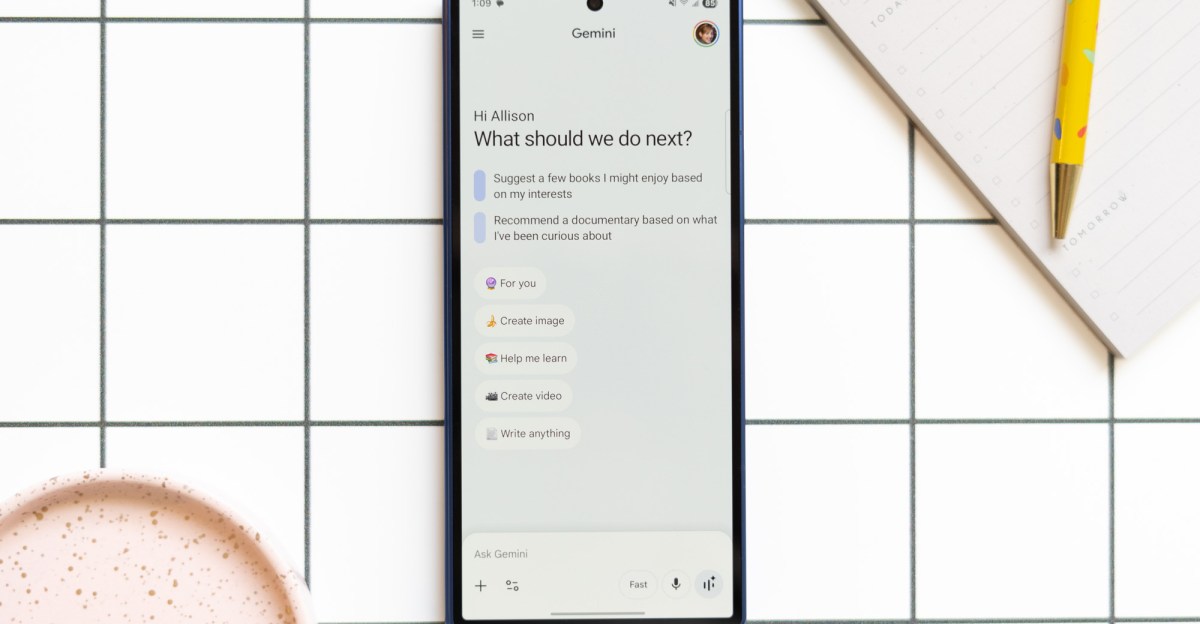
Gemini has demonstrated significant advancements. The platform has progressed rapidly, surpassing OpenAI in some areas, excelling at generating convincing imagery, and even securing a partnership with Apple. Therefore, the recent announcement of “Personal Intelligence” seemed like a natural progression. Personal Intelligence enables Gemini to reference prior conversations and access user data across various Google services, including Gmail, Calendar, Photos, and search history. This occurs without explicit prompts to search these sources. This feature is entirely opt-in, allowing users to select which applications Gemini can access. Currently, it remains in beta and is exclusively available to subscribers of AI Pro and Ultra.
This functionality may seem familiar, as Gemini previously offered integration with Workspace applications. However, the previous implementation demanded more user effort; explicit requests were often necessary for Gemini to consult emails or calendars. With Personal Intelligence, if a prompt suggests the need to check an inbox for information, such as a concert ticket email, Gemini will autonomously perform this action. This represents a significant advancement. An AI requiring highly specific prompts and constant oversight offers little more utility than basic automated assistants.
The titles it suggested were notably accurate
Upon enabling Personal Intelligence, Gemini provides suggested prompts, such as recommending books based on user interests. The book titles proposed were notably accurate. Another prompt initiated an extensive discussion on managing a problematic backyard lawn. Gemini suggested native plant options, scheduled reminders on the calendar based on the chosen plan, and compiled a shopping list in Keep for a hardware store visit. Just a few months prior, Gemini frequently failed at tasks like adding items to a calendar, making this a notable improvement.
Despite these improvements, Gemini still exhibits limitations in other areas. When asked to brainstorm new bike routes including a coffee shop stop, Gemini provided good high-level suggestions but struggled with specific details. Attempting to finalize specific routes proved challenging; links provided by Gemini, supposedly for Google Maps routes, often led to different directions upon clicking. Furthermore, a suggested route through unpaved trails in the woods, ending with a left turn across multiple lanes of busy traffic, raised safety concerns, leading to a preference for known routes.
 The ability to add calendar entries now functions effectively.
 While Cincinnati may not be classified as Rust Belt, these recommendations are quite accurate.
This highlights a core issue: Gemini can effectively analyze interests and make reasonable predictions, but it often falters on specific details. A request for recommendations of unfamiliar neighborhoods for an afternoon of photography and coffee revealed Gemini’s ability to use personal data, correctly excluding Ballard due to prior residency. While the overall list of neighborhoods was strong, the specific locations suggested were not consistently accurate.
For instance, Gemini incorrectly placed a South Park restaurant in Georgetown, suggested a non-existent Caffe Umbria in the Old Rainier Brewery, and recommended a T-shirt shop that was clearly closed according to its Google Maps listing. The need for extensive fact-checking and repeated prompting made the process feel inefficient.
The process began to feel like more effort than it was worth
This highlights Gemini’s primary immediate challenge. Previously, accessing personal information required significant oversight, and errors were common. While the personal data integration is now more reliable, inaccuracies in details remain a significant flaw. A single instance of being directed to a closed business can deter users from further engagement with Gemini. Beyond functionality, privacy concerns also arise. Gemini, in a conversation, referenced the user’s husband and child by name. While this information might be easily accessible via email and calendar, hearing it vocalized by an AI presents a different level of privacy implication.
Despite these reservations, the integration of Personal Intelligence has marginally expanded Gemini’s utility for the user, though its daily usage remained limited initially. For tasks like yard work, a schedule and shopping list were generated, with plans to consult human experts at a local nursery for verification. Using Gemini for initial planning might provide enough confidence to begin tasks, even if adjustments are needed later. This represents a useful, albeit cautious, application of the tool, with the understanding that any AI-recommended path requires careful verification.
