
Close Menu
    Latest Post

    Anker’s X1 Pro shouldn’t exist, but I’m so glad it does

    February 22, 2026

    Suspected Russian Actor Linked to CANFAIL Malware Attacks on Ukrainian Organizations

    February 22, 2026

    Trump Reinstates De Minimis Exemption Suspension Despite Supreme Court Ruling

    February 22, 2026
    Facebook X (Twitter) Instagram
    Trending
    • Anker’s X1 Pro shouldn’t exist, but I’m so glad it does
    • Suspected Russian Actor Linked to CANFAIL Malware Attacks on Ukrainian Organizations
    • Trump Reinstates De Minimis Exemption Suspension Despite Supreme Court Ruling
    • How Cloudflare Mitigated a Vulnerability in its ACME Validation Logic
    • Demis Hassabis and John Jumper Receive Nobel Prize in Chemistry
    • How to Cancel Your Google Pixel Watch Fitbit Premium Trial
    • GHD Speed Hair Dryer Review: Powerful Performance and User-Friendly Design
    • An FBI ‘Asset’ Helped Run a Dark Web Site That Sold Fentanyl-Laced Drugs for Years
    Facebook X (Twitter) Instagram Pinterest Vimeo
    NodeTodayNodeToday
    • Home
    • AI
    • Dev
    • Guides
    • Products
    • Security
    • Startups
    • Tech
    • Tools
    NodeTodayNodeToday
    Home»Tools»Introducing Uniffi for React Native: Rust-Powered Turbo Modules
    Tools

    Introducing Uniffi for React Native: Rust-Powered Turbo Modules

    Samuel AlejandroBy Samuel AlejandroJanuary 23, 2026No Comments3 Mins Read
    Share Facebook Twitter Pinterest LinkedIn Tumblr Reddit Telegram Email
    src 198bugl featured
    Share
    Facebook Twitter LinkedIn Pinterest Email

    Mozilla and Filament have released Uniffi for React Native, an open-source tool designed for building React Native Turbo Modules using Rust. This development enables millions of developers creating cross-platform React Native applications to leverage Rust, a modern programming language recognized for its safety and performance. Developers can now create single implementations of their app’s core logic that function seamlessly across iOS and Android.

    This release is significant for Filament, which co-developed the library with Mozilla and lead developer James Hugman. The tool aims to benefit many other developers by offering advantages such as reduced code, improved memory safety, and enhanced performance, alongside the opportunity to utilize Rust in more development contexts.

    React Native is a popular framework for cross-platform app development, yet it presents certain challenges. Its reliance on a single JavaScript thread can lead to performance bottlenecks during complex operations. Historically, developers addressed this by either duplicating code for iOS and Android or by using C++, which can be complex to manage. Uniffi for React Native provides an improved solution, allowing developers to offload demanding tasks to Rust, which can now be easily integrated with React Native. This integration leads to faster, smoother applications and a more efficient development workflow.

    How Uniffi for React Native Works

    Uniffi for React Native functions as a uniFFI bindings generator, enabling the use of Rust within React Native through Turbo Modules. It offers an abstraction level that allows developers to concentrate on application requirements, avoiding the intricate details of native cross-platform development. The tooling generates:

    • Typescript and JSI C++ for calling Rust from Typescript and vice versa
    • A Turbo-Module that integrates the bindings into a running React Native library.

    The ongoing development of this project is significant. In 2020, Uniffi was introduced as a ‘write once; run anywhere’ toolset for Rust. Its evolution began as a method to achieve a single Rust implementation for Firefox Sync’s core, deployable across Android and iOS applications. Since then, Mozilla has successfully utilized uniffi-rs to integrate Rust into mobile and desktop products, reaching hundreds of millions of users. This Rust code powers critical subsystems like bookmarks and history sync, Firefox Suggest, telemetry, and experimentation. Beyond Mozilla, Uniffi is also employed in Android (in AOSP), high-profile security products, and various complex libraries within the community.

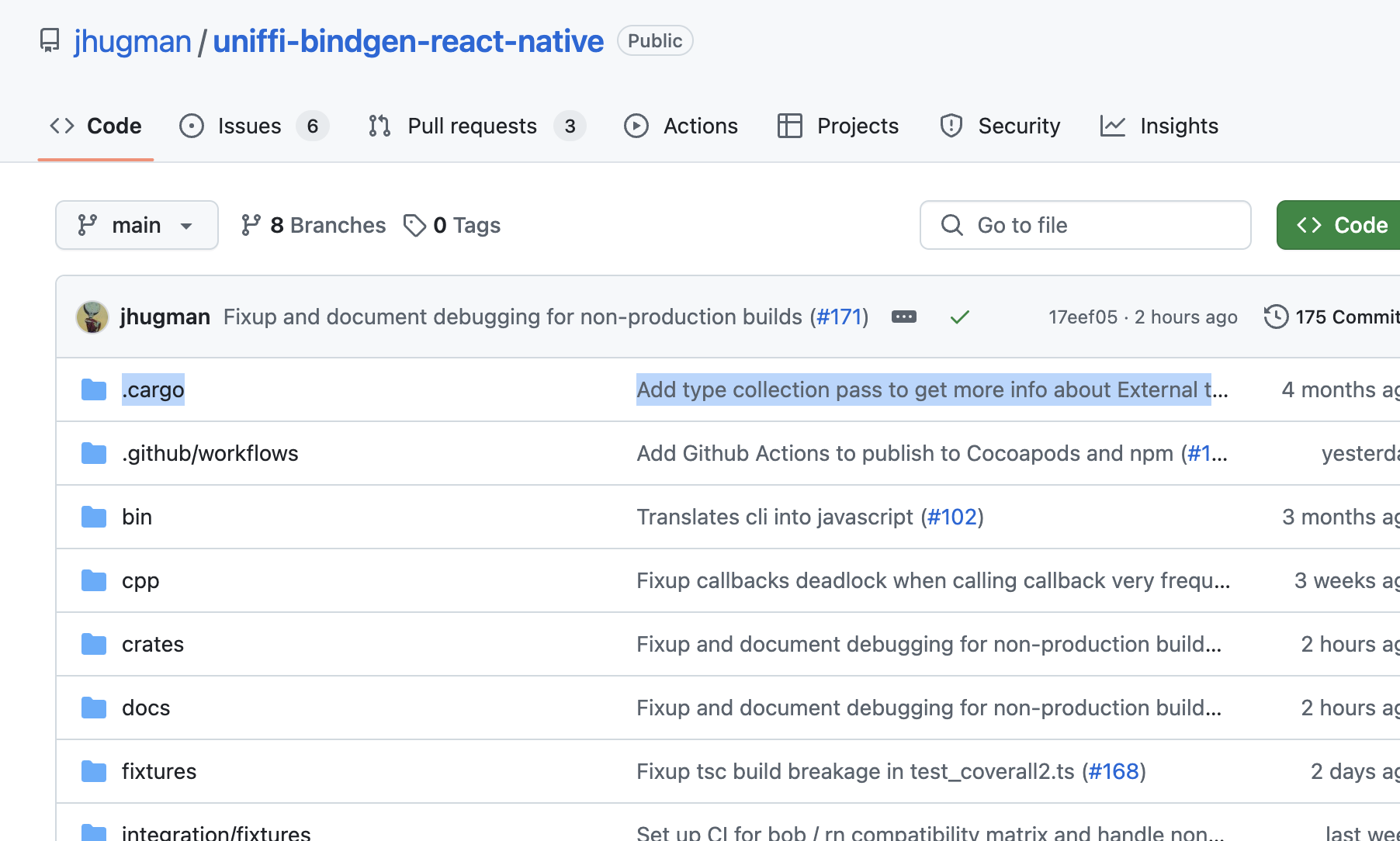
    Uniffi for React Native is currently in an early release phase. While a dedicated landing page and repository examples are under development, open-source contributor Johannes Marbach, sponsored by Unomed, has already utilized Uniffi for React Native to develop a React Native Library for the Matrix SDK.

    Potential applications for Uniffi for React Native include two key areas:

    • Utilizing Rust to offload computationally intensive code to a multi-threaded and memory-safe subsystem, thereby mitigating single-threaded JavaScript performance bottlenecks in React Native.
    • Leveraging the extensive library of Rust crates within React Native applications. For instance, a Filament developer recently demonstrated this by replacing a slow Typescript implementation with a fast blurhashing library from crates.io, achieving functional integration within a single day. The aim is to further enhance tooling to simplify such optimizations.

    Uniffi marks a significant advancement in cross-platform development, merging the capabilities of Rust with the adaptability of React Native to open new avenues for application developers.

    Share. Facebook Twitter Pinterest LinkedIn Tumblr Email
    Previous Article5 Alternatives to Google Colab for Long-Running Tasks
    Next Article Odoo’s Valuation Soars to €7 Billion Following General Atlantic’s Increased Investment
    Samuel Alejandro

    Related Posts

    Tools

    How Cloudflare Mitigated a Vulnerability in its ACME Validation Logic

    February 21, 2026
    Tools

    Mozilla Leaders Advocate for Open Source AI as a Path to Sovereignty at India AI Impact Summit

    February 21, 2026
    Guides

    Unlock Instant Gaming Performance on Your Laptop with This GPU Setting

    February 21, 2026
    Add A Comment
    Leave A Reply Cancel Reply

    Latest Post

    ChatGPT Mobile App Surpasses $3 Billion in Consumer Spending

    December 21, 202513 Views

    Creator Tayla Cannon Lands $1.1M Investment for Rebuildr PT Software

    December 21, 202511 Views

    Automate Your iPhone’s Always-On Display for Better Battery Life and Privacy

    December 21, 202510 Views
    Stay In Touch
    • Facebook
    • YouTube
    • TikTok
    • WhatsApp
    • Twitter
    • Instagram
    About

    Welcome to NodeToday, your trusted source for the latest updates in Technology, Artificial Intelligence, and Innovation. We are dedicated to delivering accurate, timely, and insightful content that helps readers stay ahead in a fast-evolving digital world.

    At NodeToday, we cover everything from AI breakthroughs and emerging technologies to product launches, software tools, developer news, and practical guides. Our goal is to simplify complex topics and present them in a clear, engaging, and easy-to-understand way for tech enthusiasts, professionals, and beginners alike.

    Latest Post

    Anker’s X1 Pro shouldn’t exist, but I’m so glad it does

    February 22, 20260 Views

    Suspected Russian Actor Linked to CANFAIL Malware Attacks on Ukrainian Organizations

    February 22, 20260 Views

    Trump Reinstates De Minimis Exemption Suspension Despite Supreme Court Ruling

    February 22, 20260 Views
    Recent Posts
    • Anker’s X1 Pro shouldn’t exist, but I’m so glad it does
    • Suspected Russian Actor Linked to CANFAIL Malware Attacks on Ukrainian Organizations
    • Trump Reinstates De Minimis Exemption Suspension Despite Supreme Court Ruling
    • How Cloudflare Mitigated a Vulnerability in its ACME Validation Logic
    • Demis Hassabis and John Jumper Receive Nobel Prize in Chemistry
    Facebook X (Twitter) Instagram Pinterest
    • About Us
    • Contact Us
    • Privacy Policy
    • Terms & Conditions
    • Disclaimer
    • Cookie Policy
    © 2026 NodeToday.

    Type above and press Enter to search. Press Esc to cancel.