


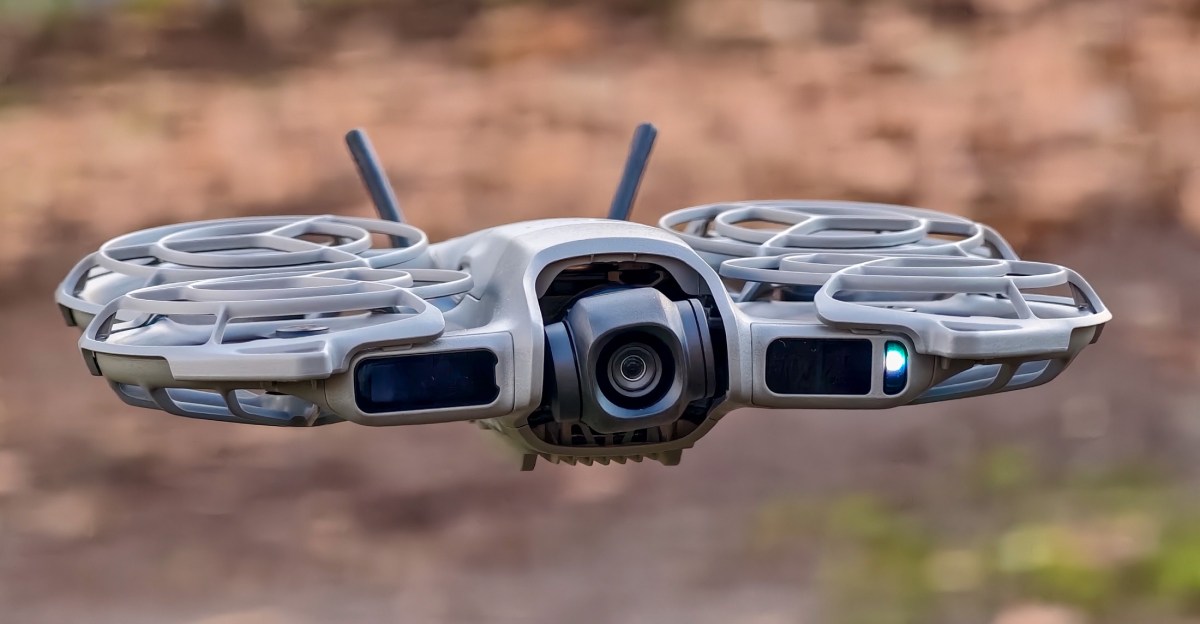

The Neo 2 looks a lot like the first Neo, but it’s had plenty of upgrades.
Many individuals might feel hesitant about drones due to their size, fragility, and cost. Despite these concerns, the appeal of capturing aerial photos and videos often sparks interest.
DJI has consistently aimed to develop more compact, user-friendly, and affordable drones. The original Neo, priced at $199, was a step in this direction but had limitations such as basic obstacle avoidance and the initial absence of portrait video recording. Other models like the fold-down Flip offer advanced features but come at a higher cost of $439, making them less accessible for beginners. Similarly, the competitor HoverAir X1 is priced at $349.
The Neo 2 addresses these previous issues. Priced at £209 / €245, it is slightly more expensive than its predecessor but remains more affordable than many competitors. While an official US release is pending, it can be purchased for $259 from authorized reseller DJI USA and select third-party sellers on Amazon. A DJI representative confirmed that the drone received FCC certification prior to the company’s effective ban from the US, though a timeline for official US availability is not yet established.
At $259, the Neo 2 offers camera enhancements and better, though still imperfect, obstacle detection compared to the original Neo. Its compact and lightweight design allows for flight in many locations without extensive regulatory concerns. It can capture excellent footage and photos without a dedicated controller and includes manual control and FPV flight options, making it versatile as both a recreational device and an aerial camera.
While more advanced drones may offer superior cameras, higher speeds, or extended battery life, the Neo 2 serves as an excellent entry point for many users. It provides an affordable and low-risk opportunity to discover the enjoyment of drone flight.
For a straightforward user experience, the Neo 2 can be easily carried, even without a controller or phone. This approach highlights its accessibility.
Weighing 151g, or 160g with an optional transceiver, the Neo 2 is slightly heavier than its predecessor but remains highly portable. Its weight is also below the 250g threshold, which often triggers more stringent regulations in various countries.

The Neo 2 is light enough that it can be flown almost anywhere, even in city parks.
Operating the Neo 2 is straightforward. A few button presses activate the device, and its on-board controls are intuitive. Two side buttons allow cycling through automatic flight modes, while a long press enables adjustments to parameters such as height, distance, or filming angle. To launch, simply hold the drone flat in your hand and press the start button.
The Follow mode is a highly utilized feature that performs effectively. Users have ample control over the Neo 2’s positioning, distance, and angle. While its top speed of 12m/s (approximately 26mph) is modest compared to larger drones, it is sufficient for tracking a runner, though it might struggle to keep pace with faster cyclists.
Obstacle detection is a crucial aspect, and users should listen for changes in propeller sounds. During testing among trees, the Neo 2 demonstrated an ability to reroute around trunks. However, it occasionally encountered issues with low-hanging, thin branches, especially those lacking winter foliage. In one instance, it became entangled but managed to free itself and resume tracking. In another, it became stuck and powered down, requiring manual retrieval. Deliberately obstructing its view with a large tree trunk caused the Neo 2 to hover, losing track. Nonetheless, under normal usage, its tracking capabilities are generally reliable.
Despite its lightweight construction, the Neo 2 proves to be quite durable. It comes with removable propeller guards, and even after several minor crashes and collisions during testing, the body remained free of scratches or scuffs. The drone is not waterproof, so it should be kept away from rain. Its robust design allows for casual transport, such as in a gym bag, without excessive concern. The transceiver antennae, part of more expensive bundles, are a minor concern due to their screw-fastened attachment for removal, but their flexibility appears to offer adequate protection.

This small display provides basic information for the drone’s automatic modes.

Plastic propeller guards are installed by default, but can be removed.

The drone features a sharp, compact design.
In addition to Follow mode, other automatic options are designed for rapid photo and video capture. These include Dronie, which involves the drone flying backward and upward while filming; Rocket, where it ascends and descends during filming; and Circle, a self-explanatory circular flight path. Further options are available, and the DJI Fly app allows for customization of these drone shortcuts.
Video quality sees moderate enhancements over the original Neo. The camera retains its half-inch-type sensor and 4K resolution, but benefits from a wider f/2.2 aperture and an increased frame rate from 30fps to 60fps for 4K video, or 100fps for slow-motion. Vertical video recording is also upgraded to 2.7K resolution at 60fps, a significant improvement from its previous 1080p limit.

In daylight, photo quality is comparable to many smartphones.

However, highlights can sometimes be overexposed, and shadows may appear slightly crushed.
The Neo 2’s camera performance may not rival that of larger or more expensive drones, particularly struggling with highlights from direct bright light or overexposing lighter skin tones. However, its primary appeal lies in its compact, phone-like size, ease of use, and comparable video quality, all while offering aerial capabilities and subject tracking that a smartphone cannot.
Direct control of the drone is possible without a phone, utilizing built-in gesture controls. These simple gestures allow commands such as raising, lowering, backing away, or landing in the palm of a hand, proving surprisingly practical. Basic voice controls are also available, though they require a phone to pick up audio, making touchscreen controls often more convenient.

Higher-priced bundles include a transceiver equipped with antennae for extended range.

Manual controls can be accessed via a smartphone or a dedicated remote, such as DJI’s RC-N3.
For manual operation, the drone can be controlled directly through the DJI Fly app or with a remote like DJI’s RC-N3, which comes with two spare batteries in the $429 / £349 / €405 Fly More Combo, nearly doubling the drone’s standalone price. Users can select from regular, slower Cine, or faster Sport flight modes. Obstacle handling can also be configured: the drone can stop, automatically navigate around obstacles, or have obstacle detection entirely disabled for full manual control.
FPV (First-Person View) support is also available, though the goggles and motion controller from the $599 / £509 / €589 Motion Fly More Combo were not tested. A previous review by a colleague, Sean Hollister, indicated that the Goggles N3, tested with the original Neo, did not receive a strong recommendation.
Despite its compact size, the Neo 2 offers surprisingly agile flight performance, complemented by effective 2-axis stabilization. During windy conditions in London, the drone maintained stability by flying at a noticeable slant, only experiencing significant movement when slowing for landing, necessitating a manual catch for safety. Regular flight footage remains remarkably steady even when the drone itself is angled, though more complex maneuvers, such as a dolly zoom in similar conditions, resulted in jerky and disorienting video.
To preempt potential issues, range limitations were tested. When flown beyond approximately 120m/400ft using a phone as a remote (range is extended with a transceiver and dedicated RC), video transmission became choppy, followed by an error message, triggering the drone’s automatic return-to-home function.
Choosing a safe takeoff location is important, as it impacts the Neo 2’s ability to return safely. Launching from beneath a tree, for example, could cause the drone to attempt a high-arc return, potentially leading it to descend through upper branches. While the Neo 2 features omnidirectional obstacle avoidance, caution is advised, especially after previous experiences with the drone getting entangled in lower branches.

The Neo 2 is not waterproof, though DJI states it can be flown over water.
Regarding battery life, the Neo 2 offers 15-20 minutes of flight time on a full charge. For safety, it initiates an emergency landing before the battery level drops to single digits, resulting in a practical runtime closer to the lower end of this range. For extended use, purchasing additional spare batteries, available in DJI’s Fly More Combo with the remote control, is recommended.
The drone does not require or support an SD card for storage, instead featuring 49GB of internal space, which is more than double the 22GB of the previous model. Approximately 15 minutes of 4K test footage and several photos consumed only 6GB, suggesting that users can record several hours of content before needing to offload files.
A notable drawback of the overall experience is the DJI Fly app, used for drone management. On Android, it can be somewhat cumbersome. The app defaults to landscape mode upon opening but then prompts users to switch to portrait mode when accessing flight controls, the video editor, or the safe flight zone map. Its interface is cluttered, clunky, and lacks intuitive navigation, offering minimal assistance for fundamental tasks such as connecting to the RC controller.
Acquiring the app can also be inconvenient; Android users must download it directly from the DJI website as it is not available on the Google Play Store. iPhone users, however, can find it in the App Store, a situation DJI indicates will remain unchanged despite any bans.
While experienced drone enthusiasts might find the Neo 2’s limitations restrictive, its strengths lie in its compact size, versatility for flight in various locations, and ease of operation for a broad audience. For those not seeking a high-end FPV model, the Neo 2 offers a compelling and sufficient drone experience.
