


BASF Agricultural Solutions integrates innovative products and digital tools with farmer expertise, offering a comprehensive range of solutions from seeds to digital agriculture. The company aims to sustainably address societal needs through collaboration. Infosys, a global consulting partner of Amazon Web Services (AWS), assists customers in business transformation by integrating software and services. This article examines how this partnership is advancing positive change in agriculture, specifically by utilizing Amazon Managed Blockchain to tokenize food and cotton value chains, thereby enhancing traceability, climate action, and circularity.
Global challenges and the agricultural industry
The global population is expanding, with UN projections indicating 8.5 billion people by 2030 and 10.4 billion by century’s end. This growth, coupled with rising living standards, increases the demand for agricultural products like fiber and food. Concurrently, there is a growing societal awareness of agriculture’s ecological impact, leading to a greater emphasis on sustainable resource management from both communities and farmers. The agricultural sector thus stands at the convergence of these two significant trends.
The agricultural industry confronts intricate challenges across business and technical aspects. Business-wise, modern agricultural supply chains are highly complex, often involving many intermediaries across various nations. This complexity hinders fair pricing and adequate farmer compensation. Verifying sustainable practices and organic certifications is also increasingly difficult, despite rising consumer demand for authentic and sustainable products. Additionally, agricultural businesses must comply with growing environmental regulations, reporting demands, and complex international trade rules.
Technically, the industry faces obstacles such as limited digital infrastructure in rural farming regions, impacting internet access and technology adoption. Data collection varies significantly across farms, complicating consistent metric and reporting standards. Many agricultural businesses rely on legacy systems that are difficult to integrate with modern tracking solutions, and inconsistent data formats add further complexity. Ensuring data integrity among numerous stakeholders and implementing real-time tracking capabilities are also considerable challenges.
Cotton and fast fashion: Industry`s challenges
Cotton stands as the world’s primary natural fiber crop, with 126.5 million bales produced in the 2022–2023 season, sufficient for billions of jeans or T-shirts. It is crucial to the fast fashion industry, characterized by rapid production and disposal cycles driven by trends. Approximately 30% of US clothing sales involve cotton. This accelerated cycle contributes significantly to environmental impact, with fast fashion responsible for about 20% of global water consumption and 10% of total CO2 emissions.
The cotton industry encounters specific challenges. Water consumption is a major concern, with roughly 2,700 liters needed for one cotton T-shirt. Tracking chemical usage, such as pesticides and fertilizers, throughout cultivation is another significant hurdle. Verifying labor practices is also critical, as brands and consumers increasingly seek assurance of ethical working conditions across the supply chain.
Quality verification is also vital, as precise documentation of cotton grade and characteristics is necessary for pricing and processing. The global scope of the industry adds complexity to cross-border logistics, demanding meticulous management of international shipping and customs. Moreover, the rising significance of sustainability certification necessitates validating organic and sustainable farming practices with dependable and transparent documentation.
With increasing consumer expectations for fair practices, reduced carbon emissions, and sustainable resource use, there is a rising demand for traceability systems. These systems must offer near real-time visibility into every stage of the value chain, tracking sustainability data like water consumption and CO2 emissions.
The potential for a blockchain-based solution
In response to this demand, BASF recognized blockchain as a core technology for a digital solution to enhance value chain transparency. This solution aims to meet specific customer needs for digital assets supported by information, validation, certificates, and Know Your Business (KYB) policies for all partners in the value chain.
Blockchain technology offers a robust solution to these challenges, providing unique capabilities that directly tackle many industry issues. Fundamentally, blockchain ensures immutable record-keeping, generating permanent, tamper-proof records of transactions and events. This guarantees data integrity across the supply chain, proving particularly useful in preventing fraudulent alterations of sustainability certificates and upholding the credibility of organic farming claims.
Smart contracts, a core blockchain feature, automate compliance with agricultural standards and enable automatic payment execution based on predefined conditions. This automation substantially reduces administrative burdens in supply chain management and helps ensure equitable compensation for farmers.
Blockchain’s traceability features offer end-to-end visibility of cotton, from seed to finished garment. This allows for real-time tracking of sustainability metrics and the creation of transparent audit trails for certifications. Such transparency assists brands and consumers in verifying the authenticity and sustainability of cotton products, while also enabling farmers to showcase their dedication to sustainable practices.
Decentralized data management in blockchain allows various stakeholders to maintain shared records without a central authority, removing single points of failure in data storage and reducing reliance on centralized entities. This decentralized method is especially beneficial in agricultural supply chains, where many parties require access to and verification of information.
Blockchain’s token economics introduce new incentives for sustainable farming. Tokenization allows farmers to access new revenue streams, such as carbon credits, and build more direct relationships with buyers. Furthermore, blockchain’s digital identity features offer secure authentication for supply chain participants, enabling precise access control to sensitive data and supporting compliance with Know Your Customer (KYC) and KYB requirements.
Solution overview
BASF Agricultural Solutions has developed an innovative solution using a permissioned, open-source blockchain to foster data democratization and manage data recording, off-chain processes, and on-chain activities at scale. This system allows value chain participants to progressively verify activities independently, with an organizational structure monitoring Key Performance Indicators (KPIs) via a Distributed Autonomous Organization (DAO) interface.
To prioritize system development over blockchain infrastructure management, BASF chose Amazon Managed Blockchain and other AWS services. Amazon Managed Blockchain streamlines BASF’s strategy by providing a suite of configurable offerings that facilitate solution building without requiring additional layers or external/internal sources.
Amazon Managed Blockchain serves as a foundational system, enhancing the solution’s capacity to generate smart certificates and offering off-chain expansion opportunities, such as integration with AI and AWS Lambda. This aligns with BASF’s goal of providing top-tier solutions for farmers and delivering reliable information to communities committed to positive environmental impact.
Key Structural Components of the Solution:
- Peers – These blockchain nodes execute smart contracts (chain code) and maintain the ledger.
- Ordering service – The ordering service ensures transactions meet consensus requirements based on configured channel and endorsement policies for the installed chain code.
- Fabric certificate authority (CA) – This component enrolls and generates blockchain identities necessary for signing transactions.
- AWS services – The solution leverages various AWS services for efficient blockchain operations, including:
- Amazon Cognito – Used for onboarding external users and clients to the platform.
- AWS Fargate – A block listener, a custom service that monitors blockchain block events and updates off-chain storage, is hosted as a container on Fargate. Fargate simplifies container management by eliminating the need to manage servers or clusters of Amazon Elastic Compute Cloud (Amazon EC2) instances.
- AWS Lambda – Middleware services are hosted as Lambda functions, ensuring automatic scalability and cost-efficiency, as charges are based on function requests and execution time.
- Amazon OpenSearch Service – Utilized as an off-chain data store for complex queries to aggregate ledger data. This off-chain storage remains synchronized with the ledger and is restricted from direct updates, only allowing updates from authorized applications based on ledger events.
- AWS Secrets Manager – Used for managing blockchain identities.
- Amazon Simple Notification Service (Amazon SNS) – Connects various services asynchronously.
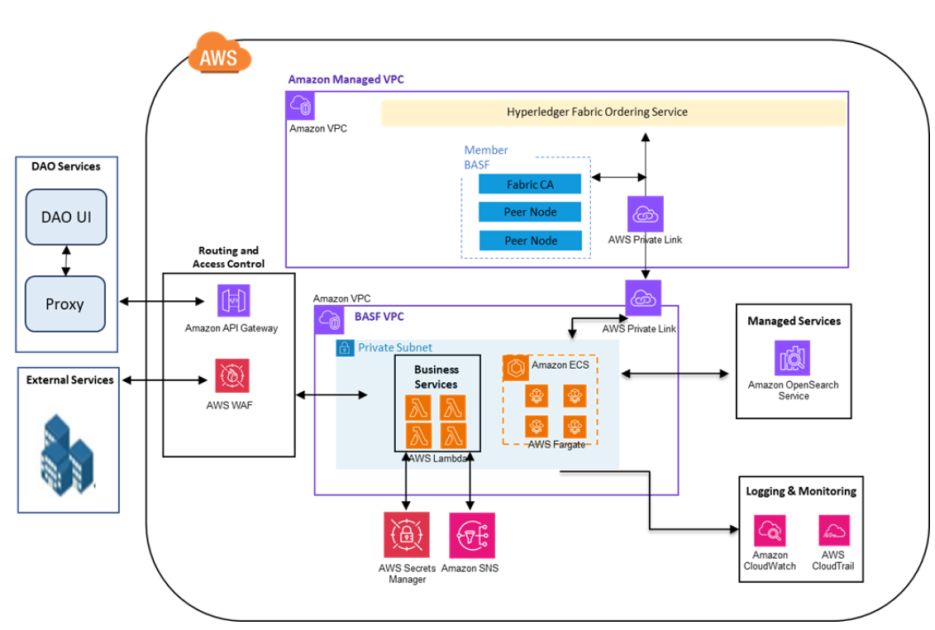
The following diagram illustrates the solution architecture.
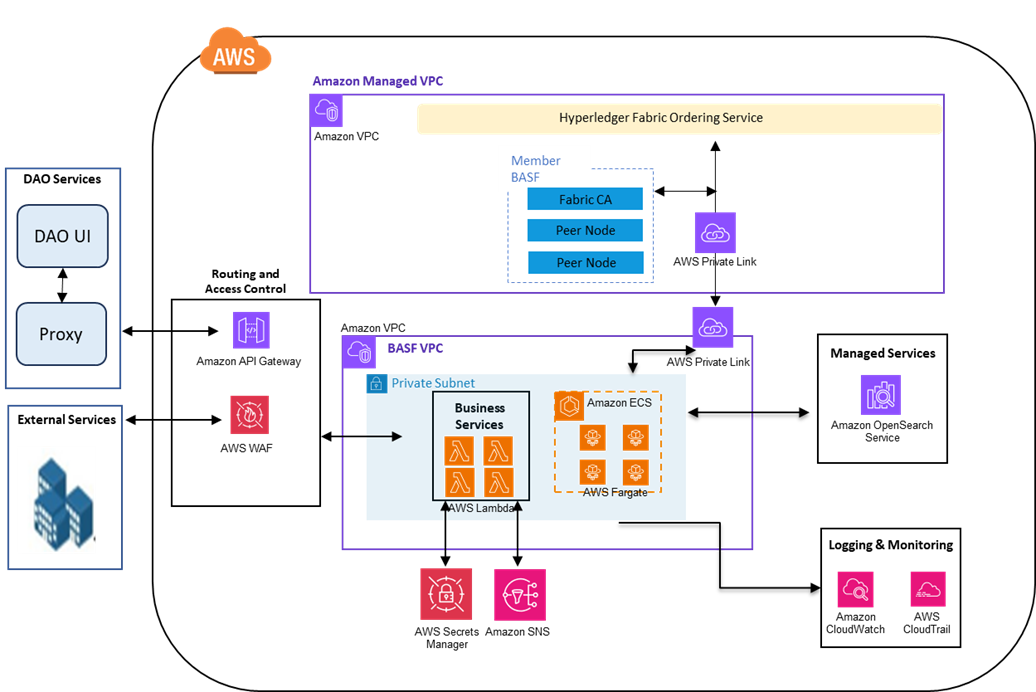
The solution architecture is designed to be extensible and scalable, capable of handling dynamic load requirements. It can integrate seamlessly with various data sources, including Salesforce, mobility platforms, and third-party services, through appropriate connectors.
External users, including value chain participants, retailers, and other beneficiaries of tokens, can access the platform via various methods. Distributed Autonomous Organizations (DAOs) typically use business-to-customer (B2C) login, while API streams are available for subscription by retailers for checkouts and point-of-sale (POS) systems. Internal access is also provided for administrators and auditors to visualize product flows.
Conclusion
Addressing climate challenges necessitates a collaborative approach involving technology, farmers as stewards of the planet, and public chains providing appropriate protocols. BASF Agriculture Solutions articulates farming needs and connects with relevant communities and crops. AWS provides the necessary cloud infrastructure and scalability, while Infosys offers development support as a partner to both AWS and BASF.
BASF engages with millions of farmers, recognizing farming as a critical global endeavor. Sustainable farming involves restoring biodiversity and enhancing soil carbon capture. Achieving overall sustainability demands extra effort from farmers. Consumers also make daily purchasing decisions, opting for sustainable products or actions that positively impact the climate.
The solution described in this article utilizes blockchain as its core technology, establishing a secure and reliable method for information sharing among all stakeholders. It provides a foundation for agricultural use cases, enabling end-to-end traceability with a comprehensive view. Smart contracts incentivize farmers and other stakeholders to adhere to sustainable practices, based on system information reviewed and authorized by validators. All system actions are monitored and recorded as immutable entries, inherently ensuring information trust. This forms a basis for complete traceability, tokenization of sustainable measures, and exchangeable digital assets, fostering a positive economy centered on sustainability. The design is adaptable for various use cases and can automatically scale to accommodate dynamic data volumes.
This initiative encourages participation in driving sustainability through trusted value chains that incentivize farmers, empower consumers, and foster a positive economy focused on climate action. For further exploration into sustainability and AWS architecture, the AWS Architecture Blog is a valuable resource.
