


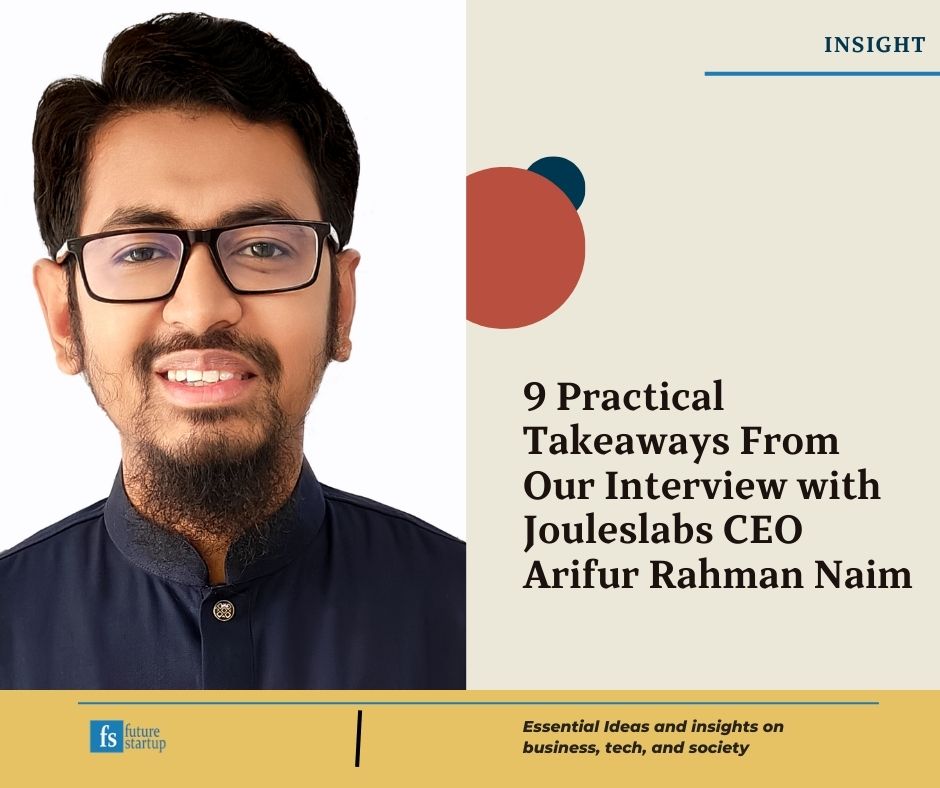
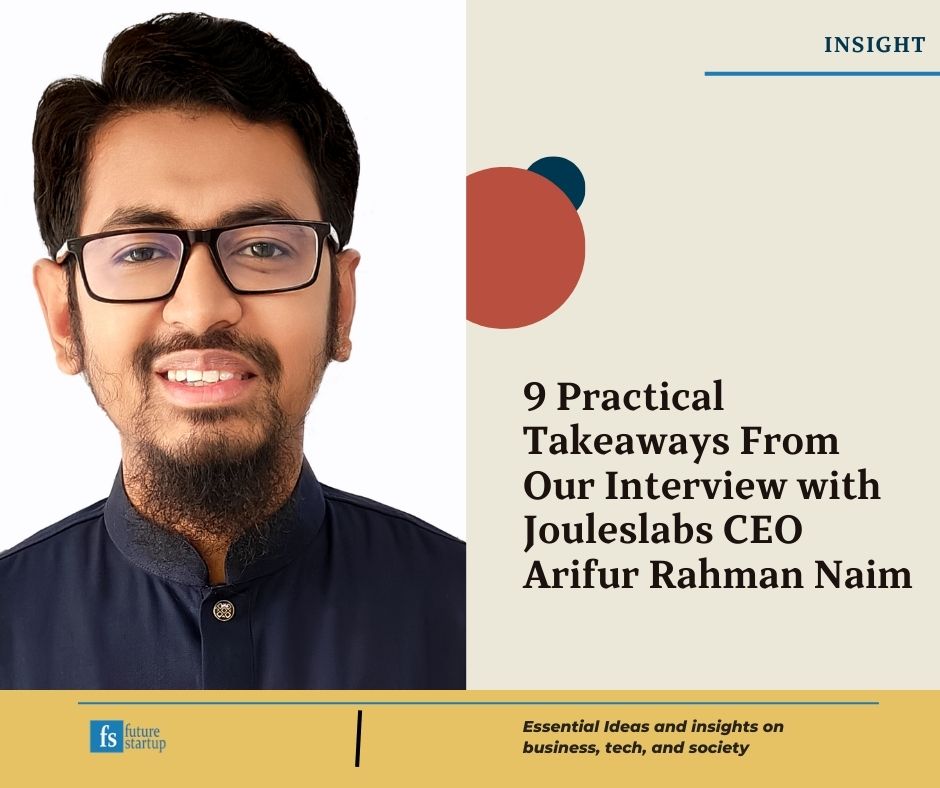
A recent conversation with Arifur Rahman Naim, co-founder and CEO of JoulesLabs, explored his unconventional path from a village near Kuakata to running a 25-30 person engineering agency. The interview covered his personal journey, his perspective on building enduring institutions, the mechanics of partnership, the reality of building a services business in Bangladesh, and the ongoing challenge of creating sustainable organizations.
JoulesLabs started in October 2017 as a sole proprietorship, landed its first contract through serendipity in Thailand, and has since worked with clients ranging from FundedNext and the Bangladesh Navy to Europe-based EV companies. But what makes this story worth examining isn’t the client list or the survival, it’s the texture of decision-making underneath, the pattern of choices that separates companies that last from those that don’t.
Nine takeaways from the interview highlight common challenges in venture building, offering specific, practical insights into how work gets done, how partnerships function, and how founders learn.
1. Agency compounds: the single most underrated startup skill
Naim’s story begins not with a technical breakthrough but with deliberate networking. While still in college, he reached out to senior developers who were succeeding in the industry. He didn’t wait for formal introductions. He reached out to people in Keraniganj and Kamrangichar who had programming tutorials on their hard drives. He became a family member to these seniors, literally having lunch with them, asking questions, building relationships.
This pattern repeated throughout his journey. When he wanted to learn from Hasin Hayder, he enrolled in a course with a clear goal: “Bhai will know me through this course.” When he needed to enter the Singaporean market, he flew to Singapore in November 2017 and closed deals worth thousands of dollars through his network. When he needed a co-founder, he spent time mapping out the exact problems that needed solving and found someone whose strengths perfectly complemented his gaps.
The lesson here goes beyond “networking is important.” It’s about the specific mechanics of agency: identifying what you need, figuring out who has it, and taking concrete steps to access that knowledge or relationship. Most people know they should network. Few people systematically pursue the specific connections they need with intentionality.
In practical terms, this means: don’t wait for conference introductions. If you need to learn something, find out who knows it and create a reason to sit with them. If you need access to a market, find someone already there and offer them value. The path to expertise and opportunity is almost always through people who already have what you’re seeking, but only if you’re willing to show up.
2. Institutions matter more than one admits
One of the most striking parts of Naim’s story is his description of Jhalakathi N.S. Kamil Madrasa, where 103 out of 153 students received Golden GPAs. The institution consistently produced exceptional results. Naim credits this to three things: handpicking the best teachers, giving them space to innovate, and maintaining accountability.
The principal himself wasn’t highly titled, but he managed to attract and retain teachers who were. He gave them autonomy while creating systems that ensured performance. This is a masterclass in institution building: find exceptional people, get out of their way, and create mechanisms that allow excellence to flourish.
Why does this matter for startups? Because companies are institutions too. The patterns that create excellent schools, selecting for passion, granting autonomy, maintaining accountability, are the same patterns that create excellent companies. JoulesLabs later applied this exact framework: find passionate engineers, give them flexibility (like open office hours), and create feedback systems that reinforce the culture you want.
Exceptional outcomes don’t come from exceptional individuals working in mediocre systems. They come from good people operating in well-designed institutions. If you want different results, build different institutions.
3. In partnership, commitment is everything
JoulesLabs ran for three years as a sole proprietorship before Naim brought on Mehedi Hasan Nahid as co-founder in 2021. By then, Naim had learned exactly what problems his business faced. He needed someone who could own the technical side completely so he could focus on business development. Nahid had already run a partnership that failed, so he understood the pitfalls.
The most interesting part of their partnership agreement wasn’t about equity splits or financial arrangements. It was about commitment. They explicitly agreed that neither would affiliate with anything else for a certain number of years. No consulting on the side. No 5% stakes in other ventures. Full attention, all in.
Naim is emphatic about this: “If there is shared attention, this is purely a red flag. It can be roughly said that it won’t work.”
In a partnership, you’re not just combining capital, you’re combining effort, attention, and judgment. If one partner is splitting attention, the entire leverage of the partnership breaks down. You end up with half of two people instead of the multiplied force of one focused unit.
Before entering any partnership, have an explicit conversation about commitment. Not theoretical commitment. Actual, operational commitment. Where will each person’s time go? What other projects exist? What would cause someone to split focus? Get these answers before you formalize anything, because “shared attention” is the silent killer of most partnerships.
4. Marketing isn’t optional
When asked about mistakes, Naim doesn’t hesitate: “The importance of marketing was realized very late.” He estimates that understanding marketing earlier could have compressed nine years of work into nine months, a 12x difference in outcomes.
This is particularly striking because JoulesLabs is a services company, not a product company. Services businesses often assume that delivery quality and word-of-mouth will be sufficient. They focus on being good at what they do and hope clients will find them. But as Naim learned, “being an agency from a third-world country serving first-world countries” requires active marketing to establish trust and visibility.
5. Process debt compounds like technical debt
For the first three years, JoulesLabs operated in what Naim calls “reactive mode.” There were no SOPs, no established processes, just run-time decisions made on the fly. This worked when the team was small and Naim could stay close to everything. But as the company grew, this lack of process became a drag on growth.
After bringing Nahid on as co-founder in 2021, they systematically built out processes: project management protocols, client interview frameworks, quality assurance systems, feedback mechanisms. They started assigning project managers to handle credentials and R&D so engineers could focus on coding. They created clear separation between POCs, technical research, and QA.
Naim identifies the lack of early process work as a major strategic mistake. Not a minor operational inefficiency, but a fundamental error that limited growth.
Yes, early-stage companies need speed. But speed without process creates its own kind of debt, let’s call it process debt, that must eventually be repaid. And like technical debt, the longer you wait to address it, the more expensive the correction becomes.
Don’t wait until processes are desperately needed to start building them. When you notice yourself making the same decision repeatedly, document it. When you notice friction in handoffs between people, create a protocol. Early process work feels like overhead when you’re small, but it’s actually investing in future capacity.
6. Community engagement is hiring insurance
Before starting JoulesLabs, Naim was active in the developer community. He helped organize DevTravelers, a travel group for developers that conducted 25-30 trips. He volunteered at industry events. He was a visible face in the community.
When it came time to hire, this community engagement paid massive dividends. “A job circular could be posted, or even before getting an office, people were hired. People were like ‘Bhai, you started this, we are with you.’ Community engagement helped tremendously in initial team building, which was perhaps smoother than for better-established agencies at that time.”
This is hiring insurance. Most companies struggle to hire because they’re unknown. They have to compete purely on compensation, which they often can’t match. But if you’ve built trust and visibility in a community, people join because of relationship and mission, not just money.
The mechanism is simple: community engagement creates familiarity. Familiarity creates trust. Trust lowers the perceived risk of joining an unknown company. In talent-scarce markets, this advantage can be the difference between getting your first choice candidate or your fourth.
If your business depends on hiring specific types of talent, invest time in the communities where that talent congregates. Speak at meetups. Organize events. Contribute to open source. Make yourself known for something other than being an employer. When you eventually need to hire, you’ll be recruiting from warm connections instead of cold outreach.
7. Engineers care about impact, not just money
One of JoulesLabs’ core realizations was that engineers evaluate projects differently. Engineers don’t just look at financial compensation; they look at technical challenges and learning opportunities. Naim is explicit: “Even if the money is low, if the engineering challenge is significant, it might be taken. Or if an early-stage founder has money but it’s clear it won’t work, or he isn’t well prepared, a pass might be made.”
This inverts the typical services business logic, which says you should maximize revenue per project. Instead, JoulesLabs filters projects through a different question: “Can I sell this project to the engineers?” If the work offers meaningful technical challenge or learning, it’s worth considering even at lower margins. If the work is uninspiring, it’s not worth it even at premium rates.
Engineers who feel entitled and challenged stay longer, produce better work, and require less management. Engineers who feel like code monkeys on boring projects leave for the next incremental salary bump. In a services business where people are your product, culture and motivation matter more than short-term project profitability.
Understand what your team actually cares about and optimize for that, not for what you assume they care about. For engineers, that’s often technical growth. For designers, it might be portfolio quality. For sales people, it might be deal ownership. Design your project selection and resource allocation around these motivators, and you’ll get better outcomes at lower cost.
8. Client interviewing is mutual due diligence
Most service providers treat client relationships as supplicant to benefactors, they’re grateful to get the work and afraid to push back. JoulesLabs does the opposite. They interview potential clients before taking on projects.
Naim explains: “There is a step where the client is interviewed before onboarding a project. If their idea is felt not to work because their distribution plan isn’t good, it’s known that the tech team will later be blamed if it doesn’t work, so the concern is communicated.”
This serves two purposes. First, it filters out projects likely to fail for non-technical reasons. If a client has an unrealistic plan or insufficient preparation, the project will probably fail, and JoulesLabs will get blamed even if they execute perfectly. Better to decline upfront.
Second, it establishes the relationship on equal footing. By interviewing the client, JoulesLabs signals that they’re selective, that they have standards, that they’re a partner rather than a vendor. This changes the entire dynamic of the relationship.
In B2B services, you’re not just selling execution, you’re selling judgment. Clients who want pure execution can find cheaper options offshore. Clients who want partnership value vendors who push back, who ask hard questions, who care whether the overall plan makes sense. Client interviewing demonstrates that you have skin in the game beyond just collecting a check.
Create a qualification framework for projects. What makes a good client? What makes a project likely to succeed? What red flags suggest a project will fail regardless of technical execution? Document these criteria and actually use them to say no to work that doesn’t meet your standards.
9. Learning requires systematic pursuit, not passive exposure
When asked about his learning process, Naim describes something specific and repeatable: “Suppose I have a marketing challenge. I’ll try to find the right person within the network whom I respect for that subject. Sit one-on-one with them, or find multiple people and talk to them, then figure it out. Finding out where I’m lacking or what I want to learn, who is the expert in that already? Someone in my close vicinity.”
He then takes this a step further: “Going to experienced people, gathering insights from them at a high level, converting it into a syllabus, taking notes by talking to them, and figuring it out. Then, if there’s any book, podcast, or course material on that topic, now, because of AI, many things are much easier, taking that, learning to gain skills, learning continuously, implementing it, and bringing results.”
This is learning as deliberate practice, not consumption. Naim identifies a gap, finds people who’ve solved it, extracts their mental models, creates his own learning curriculum, and then implements it immediately. It’s a closed loop: identify → learn → apply → evaluate → repeat.
Most founders learn passively. They read business books, listen to podcasts, attend conferences, hoping something will stick. But passive exposure rarely translates to capability. You might understand concepts intellectually without being able to apply them operationally.
Naim’s approach is different. He’s hunting for specific knowledge to solve specific problems. He’s going to sources (people) rather than content (books). He’s converting conversations into structured learning plans. He’s implementing immediately so he gets feedback on whether he actually understood.
Treat learning like product development. Define what you need to learn (requirements). Find the best sources (research). Create a learning plan (design). Execute the plan (build). Apply the knowledge to real problems (ship). Evaluate the results (measure). Most people skip the first step (defining what they actually need) and the last two steps (applying and measuring). That’s why most learning doesn’t compound.
The boring work of building
What stands out across these nine lessons is their ordinariness. It’s just systematic execution of known principles: be intentional about relationships, choose partners carefully, build processes early, market deliberately, understand your team’s motivations, qualify your clients, learn systematically.
This is both encouraging and sobering. Encouraging because it means building a sustainable company doesn’t require exceptional circumstances, it requires doing obvious things consistently. Sobering because it reveals why most companies fail: not because they lack the right strategy, but because they lack the discipline to execute basic operations well.
JoulesLabs is nine years old and employs 25-30 people. By most standards, the company is just getting started. But by the standards of most companies anywhere, and certainly most services companies in Bangladesh, nine years of survival and steady growth represents real achievement. Most businesses die in the first three years. Most partnerships collapse. Most agencies get stuck in reactive mode and never build real systems.
Naim’s parting words capture this: “The company has been around for nine years. But this is not considered that long a time, and in terms of business, there is still a long way to go. It is just getting started.”
That combination, respecting how far you’ve come while remaining hungry for what’s ahead, might be the most important lesson of all. Building takes time. The question isn’t whether you know what to do. It’s whether you’ll actually do it, day after day, for nine years and counting.
