


Introduction
OpenClaw has quickly become a prominent open-source project for autonomous AI agents, particularly for developers creating agents that interact with messaging applications, automate tasks, and perform actions using various tools and plugins. However, OpenClaw is not the sole solution available in 2026.
A new generation of lightweight, security-focused, and modular agent frameworks is emerging. Many of these alternatives offer simpler deployment, safer local operation, and better optimization for specific agent applications.
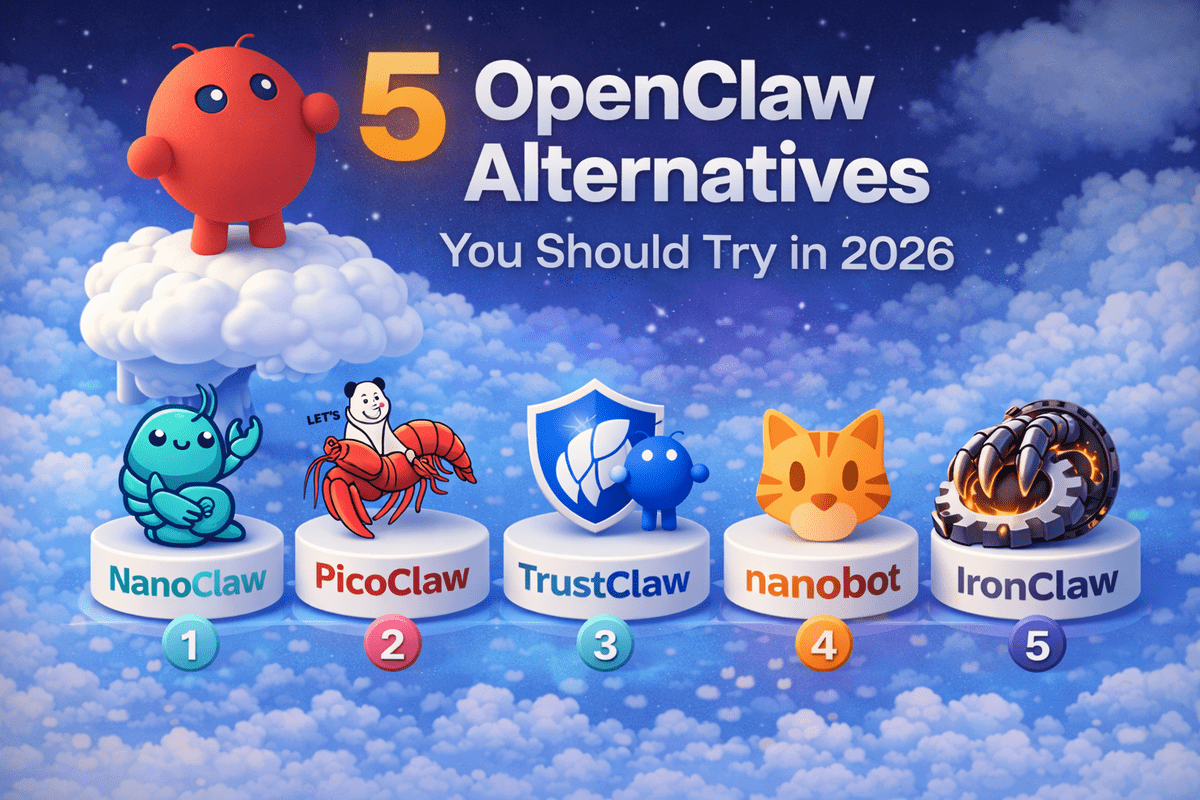
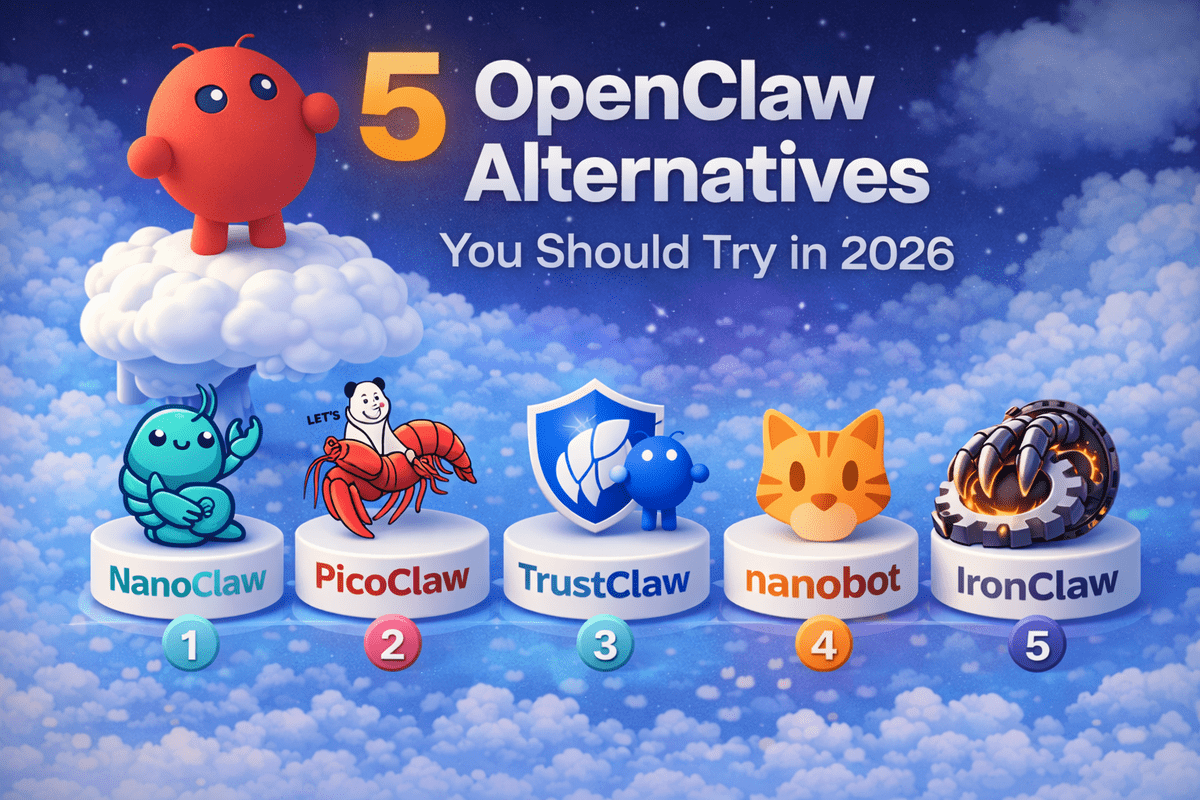
This article reviews five top open-source and commercial alternatives to OpenClaw, emphasizing their speed, smaller footprint, and design for local-first performance and security.
1. NanoClaw

NanoClaw is a lightweight alternative developed with security as a primary focus. Rather than operating with extensive system access, NanoClaw is designed to run within containers, which helps to isolate the agent’s environment and minimize potential vulnerabilities.
It offers support for messaging integrations like WhatsApp, includes memory capabilities, and can execute scheduled background tasks. NanoClaw also directly integrates with Anthropic’s Agents SDK, making it an attractive option for developers creating Claude-based workflows.
🔒 Best for teams seeking agent automation with enhanced containment and secure execution.
2. PicoClaw

PicoClaw prioritizes speed, simplicity, and portability. It is engineered to be exceptionally compact and straightforward to deploy across various environments, including local machines, containers, and lightweight edge systems.
Instead of providing a vast ecosystem, PicoClaw excels at core functionalities: automating repetitive processes, facilitating agent workflows, and maintaining a minimal design.
⚡ Best for developers desiring a rapid agent runtime without extensive infrastructure requirements.
3. TrustClaw

TrustClaw represents a more platform-centric alternative, delivering an agent experience that emphasizes usability and reliability. Unlike entirely local open-source frameworks, TrustClaw functions as a managed environment for securely operating AI agents.
This solution benefits users who require agent functionalities without the burden of managing the complete operational intricacies of a self-hosted system.
☁️ Best for users preferring a hosted and organized agent platform over custom, self-managed configurations.
4. NanoBot

NanoBot stands out as one of the most lightweight OpenClaw-style alternatives. Developed in Python, it is designed to be compact, straightforward, and easily extensible.
NanoBot offers fundamental agent building blocks, including tool integration, memory management, and messaging automation, all within a significantly smaller codebase compared to more extensive agent ecosystems.
Its inherent simplicity facilitates easier auditing and customization, particularly for researchers or developers exploring agent design principles.
💾 Best for developers seeking a clean and minimal agent framework written in Python.
5. IronClaw

IronClaw adopts a modular methodology for agent development. It is tailored for developers who require structured autonomy, adaptable tool execution, and reusable components to construct more sophisticated systems.
Although not as compact as NanoBot or PicoClaw, IronClaw offers a robust foundation for teams developing production-ready workflows and multi-tool automation pipelines.
🧩 Best for developers seeking a scalable and modular agent framework suitable for more than basic prototypes.
Final Thoughts
Here is a quick summary of which agents are best suited for different scenarios:
- NanoClaw 🔒 Best for teams seeking agent automation with enhanced containment and secure execution.
- PicoClaw ⚡ Best for developers desiring a rapid agent runtime without extensive infrastructure requirements.
- TrustClaw ☁️ Best for users preferring a hosted and organized agent platform over custom, self-managed configurations.
- NanoBot 💾 Best for developers seeking a clean and minimal agent framework written in Python.
- IronClaw 🧩 Best for developers seeking a scalable and modular agent framework suitable for more than basic prototypes.
OpenClaw played a role in popularizing the concept of local-first autonomous AI agents, but the ecosystem is rapidly evolving in 2026.
These alternatives highlight key trends in agent tooling development:
- More secure execution through containers
- Smaller and more auditable frameworks
- Easier deployment and portability
- Modular systems for serious automation use cases
For those developing agents this year, exploring these projects offers a valuable starting point.
